Choosing a reliable motorcycle helmet manufacturer requires evaluating certification experience, production capability, quality control, customization ability, and supply chain stability. A trusted manufacturer should provide consistent quality, OEM/ODM support, professional communication, and the ability to meet market requirements such as DOT, ECE, and other safety standards.
Finding the right motorcycle helmet supplier is one of the most important decisions for brands, distributors, and importers. A helmet is not only a consumer product. It is a safety product that directly affects customer trust and brand reputation.
Many companies experience problems when working with unsuitable suppliers. Common issues include unstable quality, unclear certification information, delayed delivery, poor communication, and differences between approved samples and mass production.
A reliable manufacturer should do more than produce helmets. The right partner should understand market requirements, provide technical support, manage quality risks, and help brands develop competitive products for long-term growth.
What Should Brands Check Before Choosing a Motorcycle Helmet Manufacturer?
The first step in selecting a motorcycle helmet manufacturer is evaluating whether the factory has the technical ability and production experience to support the project.
A professional manufacturer should have experience in:
| Evaluation Area | What to Check |
|---|---|
| Safety certifications | DOT, ECE, CPSC, CE experience |
| Production capability | Stable manufacturing capacity |
| Quality management | Inspection and testing systems |
| Product development | OEM and ODM experience |
| Export experience | Understanding of international markets |
Certification knowledge is one of the most important factors. Motorcycle helmets sold in different countries must meet different safety standards. For example, the US market commonly requires DOT certification, while many European markets require ECE certification.
A manufacturer with certification experience understands not only the testing process but also the production requirements behind certification. This includes maintaining consistency between tested samples and commercial products.
For brands, this reduces the risk of compliance problems, product recalls, and customer complaints.
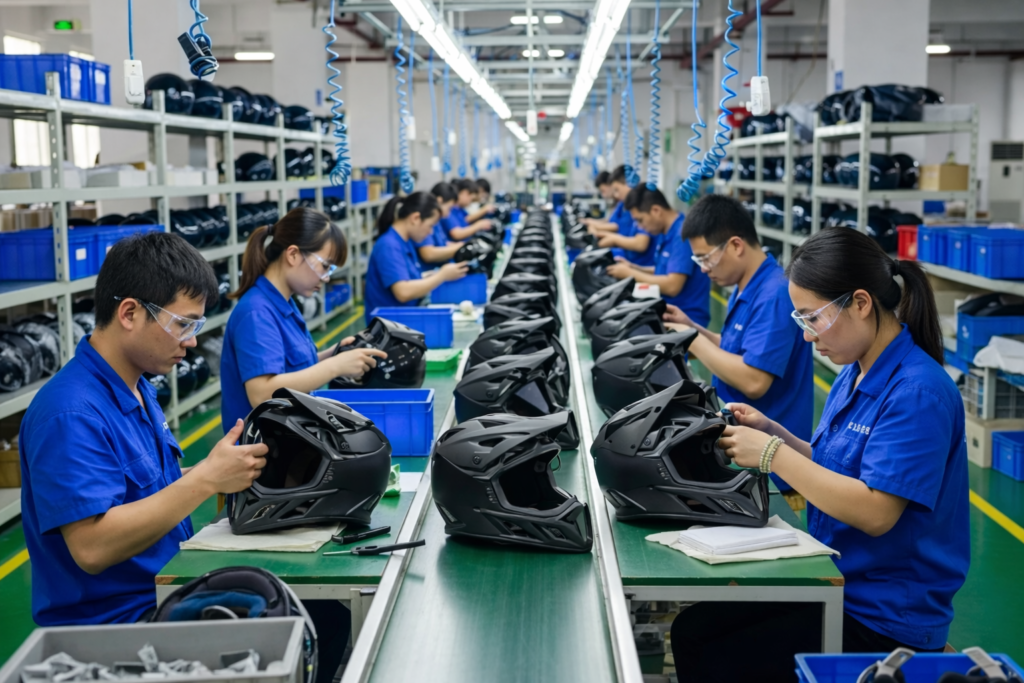
Production experience is another important factor. A factory may be able to produce a sample, but large-scale manufacturing requires stronger systems. The manufacturer must control materials, production processes, assembly accuracy, and final inspection to maintain stable quality.
Why Is Certification Experience Important When Selecting a Helmet Supplier?
Certification is not only a document requirement. It represents the manufacturer’s understanding of safety standards and product responsibility.
Different markets have different requirements:
| Certification | Market | Main Purpose |
|---|---|---|
| DOT FMVSS 218 | United States | Motorcycle helmet safety compliance |
| ECE 22.06 | Europe and international markets | Advanced helmet safety testing |
| CPSC | United States | Bicycle helmet safety |
| CE | European markets | Product safety compliance |
A reliable manufacturer should be familiar with the complete certification process, including:
- Helmet structure requirements
- Impact testing
- Retention system testing
- Visor performance
- Labeling requirements
- Production consistency
Many buyers have experienced problems where suppliers provide certification documents but cannot guarantee that mass-produced helmets match the tested products.
This creates serious risks for brands because safety complaints can damage customer confidence and market reputation.
An experienced motorcycle helmet manufacturer should maintain strict production control to ensure every batch meets the required standards.
The factory should also provide clear technical information about materials, testing procedures, and product specifications. Transparent communication helps buyers make better decisions and reduces uncertainty during product development.
How Does OEM and ODM Capability Affect Manufacturer Selection?
A manufacturer’s OEM and ODM capability shows whether it can support different brand development needs.
Many motorcycle helmet brands need more than standard products. They want customized solutions that include:
| Customization Service | Examples |
|---|---|
| Branding | Logo, labels, packaging |
| Appearance | Colors, graphics, surface designs |
| Structure | Shell design, ventilation systems |
| Materials | ABS, fiberglass, carbon fiber |
| Accessories | Visors, liners, replacement parts |
OEM capability is important for established brands that need unique products. These companies may require exclusive designs, special materials, or customized structures to create market differentiation.
ODM capability is valuable for startups and growing brands that want faster product development. Instead of creating a helmet from zero, brands can use existing factory designs and customize key features.
For premium product lines, material selection can also influence brand positioning. Lightweight materials such as carbon fiber are often used for high-performance helmets because they provide strength while reducing weight. Brands developing premium protective products may explore solutions related to carbon fiber helmets when planning advanced helmet collections.
A manufacturer with strong OEM/ODM experience can help brands balance design goals, production costs, and market expectations.
Why Is Quality Control Important When Choosing a Helmet Factory?
Quality control is one of the biggest differences between an average supplier and a reliable manufacturing partner.
A professional quality management system should include:
| Quality Control Stage | Purpose |
|---|---|
| Material inspection | Confirm raw material quality |
| Production monitoring | Control manufacturing consistency |
| Assembly inspection | Check component accuracy |
| Safety testing | Verify product performance |
| Final inspection | Prevent defective shipments |
For motorcycle helmet brands, quality consistency is more important than simply receiving a good sample.
One common supplier problem is that the sample looks excellent, but the final production has differences in:
- Shell finish
- Paint color
- Interior materials
- Visor installation
- Accessories
- Packaging details
These issues create additional costs for brands through returns, replacements, and customer service problems.
A reliable manufacturer should have clear production procedures and inspection standards. Every helmet should go through quality checks before shipment.
Stable quality also supports long-term business growth. When brands expand sales channels, they need a supplier that can maintain the same product standards across larger order volumes.
How Important Is Communication and Delivery Reliability?
Communication and delivery ability are often overlooked during supplier selection, but they directly affect business performance.
A reliable manufacturer should provide:
| Service Area | Expected Ability |
|---|---|
| Communication | Fast and clear responses |
| Sampling | Professional prototype support |
| Production updates | Transparent progress tracking |
| Delivery | Stable lead times |
| Problem solving | Quick solutions |
For motorcycle equipment brands, timing is critical. Seasonal demand, product launches, and promotional campaigns all depend on reliable delivery schedules.
A delayed shipment can result in missed sales opportunities and customer dissatisfaction.
Professional suppliers understand that manufacturing is part of the customer’s business operation. They should provide accurate production planning and communicate potential risks early.
Good communication also improves product development. When brands need changes in design, packaging, or specifications, an experienced manufacturer can provide practical recommendations based on production knowledge.
What Makes a Motorcycle Helmet Manufacturer a Long-Term Partner?
A long-term manufacturing partner provides more than production services. It supports product improvement, market expansion, and supply chain stability.
A reliable manufacturer should offer:
- Strong factory ownership and production control
- Experienced engineering teams
- Complete OEM/ODM solutions
- International certification experience
- Stable quality management
- Flexible customization options
- Professional export support
The ideal supplier understands that every helmet represents the customer’s brand. Quality problems do not only affect the factory. They affect the entire sales network and customer relationship.
Working with an experienced motorcycle helmet manufacturer allows brands to access professional development support, stable production, and customized solutions for different market needs.
Conclusion
Choosing a reliable motorcycle helmet manufacturer requires careful evaluation of certification, quality control, OEM/ODM capability, and production stability. The right partner helps brands create safe, competitive, and market-ready helmet products.