A helmet factory audit before large orders should focus on five areas: real production capability, certification control, quality consistency, document accuracy, and problem-handling discipline. A strong audit reduces the risk of sample-to-bulk mismatch, shipment delays, compliance trouble, and costly after-sales issues.
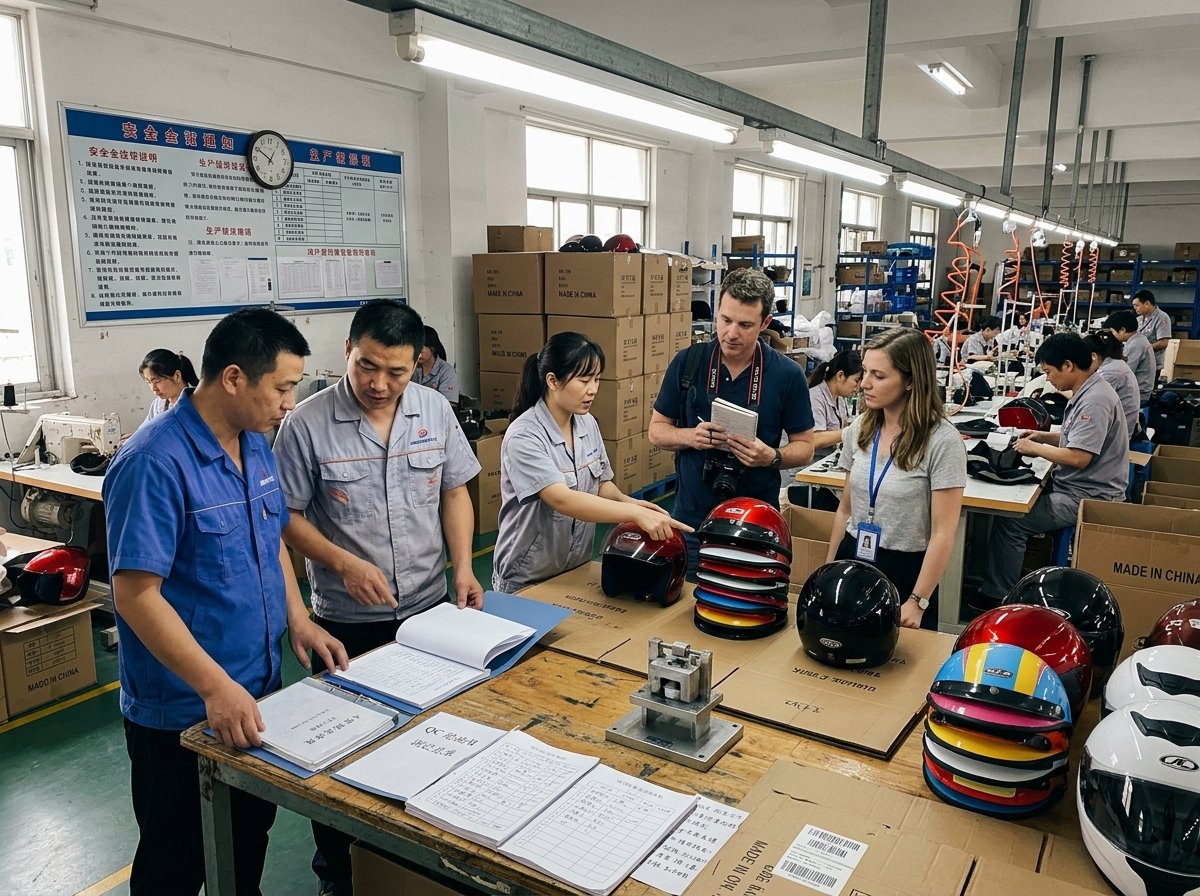
Large helmet orders often fail for predictable reasons. The sample looks good, but bulk goods arrive with different fit, weaker finishing, unstable accessories, wrong labels, or delayed packaging materials. Public market feedback around helmets shows the same pain points again and again: wind noise, fogging, pressure points, strap discomfort, visor scratches, liner failure, loose mechanisms, and poor response when problems appear. Many of those problems can be traced back to weak factory control long before the product reaches the rider.
A proper factory audit helps buyers look past polished samples and sales talk. It reveals whether the factory can actually repeat the same quality across batches, maintain certification alignment, manage OEM or ODM changes, and support large-volume delivery without losing control of details.
Why Is a Helmet Factory Audit Necessary Before Large Orders?
A factory can send an excellent sample and still perform badly in mass production. That is where many helmet sourcing problems begin. Large orders raise the risk because every weak process becomes more visible when the order moves from a few samples to hundreds or thousands of units.
A helmet factory audit is necessary because it shows whether the supplier has stable systems for production, testing, documentation, traceability, and corrective action before commercial risk becomes expensive.
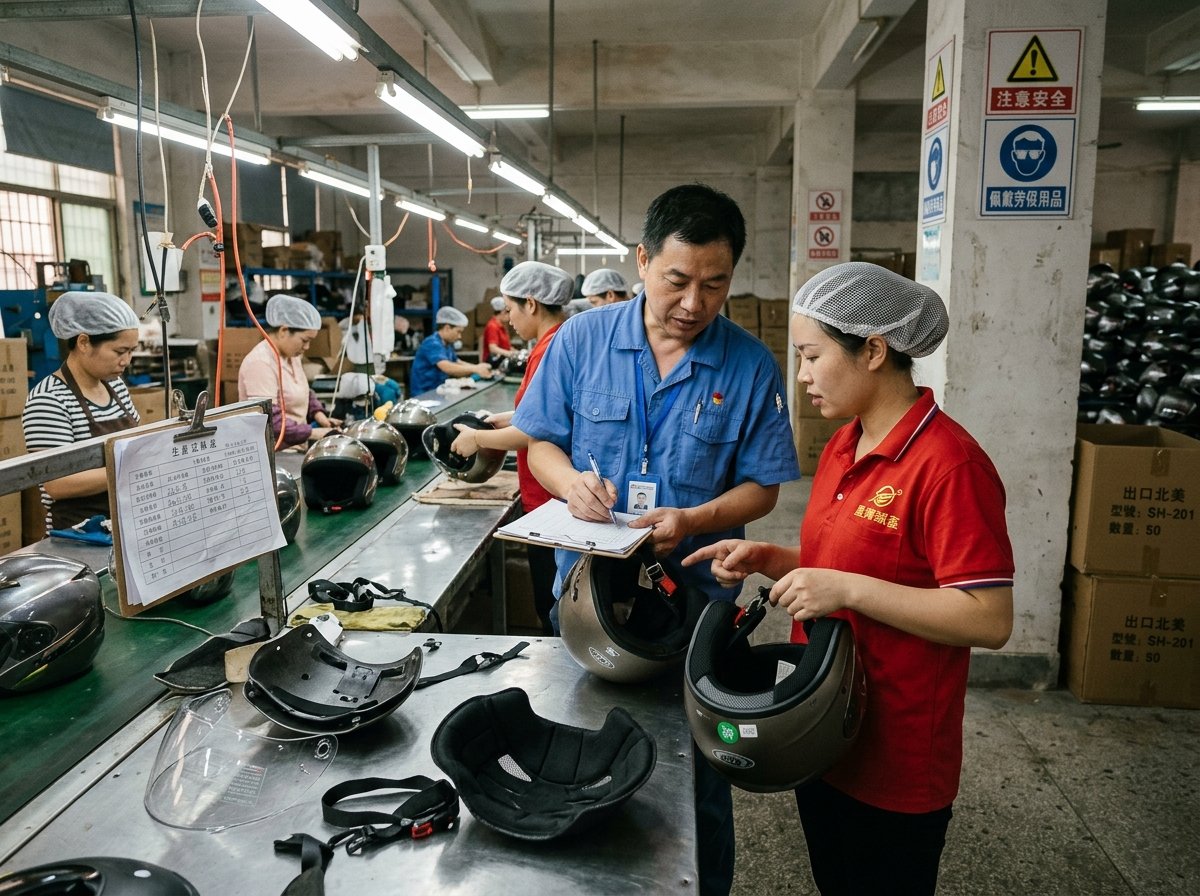
The problem is simple. Helmets are not ordinary products. They combine safety structure, comfort components, visual finishing, compliance labels, and moving parts in one item. If the shell is acceptable but the strap geometry is poor, the rider complains. If the visor mechanism is smooth on the sample but loose in production, returns increase. If the certification file exists but the shipped model does not match the tested version, the risk becomes much more serious.
This is why a document review alone is never enough. A proper audit checks the factory floor, the material flow, the QC checkpoints, the testing habits, and the way the team handles variation. In helmet projects, many complaints come from details that are easy to overlook in a catalog: padding snap buttons pulling out, cheek pads losing support, straps digging into the neck, visor seals leaking in rain, and labels or packaging not matching the market requirement. These are not random customer opinions. They are signals of weak design validation, weak process control, or both.
A strong factory audit also protects delivery planning. Large orders depend on real capacity, not claimed capacity. A supplier may show one clean production line but outsource key operations, delay packaging approval, or overload peak-season schedules. An audit helps buyers see whether production, inspection, warehousing, and shipment control are mature enough for repeat orders.
What Should Be Included in a Factory Inspection Checklist for Helmets?
Many inspections stay too general. They check whether the workshop is clean, whether workers wear uniforms, and whether machines exist. That is not enough for helmets. A useful checklist must go deeper into safety products, process discipline, and production consistency.
A helmet factory inspection checklist should cover facility capability, shell and EPS production, fit and assembly control, in-line testing, packaging accuracy, and batch traceability.
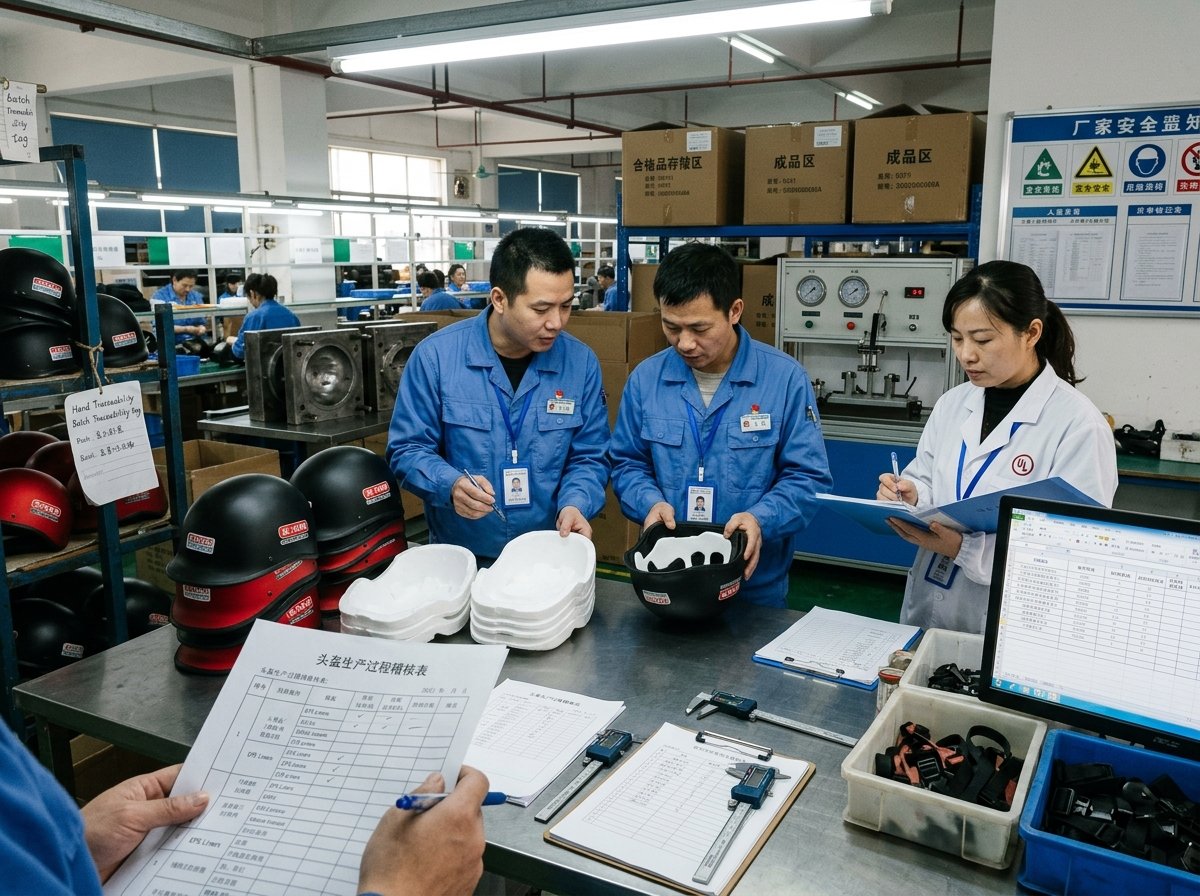
A serious checklist starts with production layout. The audit should confirm whether shell forming, EPS processing, trimming, painting, assembly, and packing are handled in-house or partially outsourced. This matters because outsourced steps often create inconsistency. Color drift, fit variation, visor installation problems, and delayed delivery frequently come from split control between different workshops.
The next step is process visibility. The audit should check whether the factory has clear work instructions for each stage. For helmets, that includes shell trimming accuracy, visor installation torque or fastening control, liner attachment checks, chin strap routing, buckle function checks, and final appearance inspection. It should also verify whether there are clear standards for rejecting defects such as scratches, paint dust, poor edge finishing, loose hardware, and label mistakes.
A strong checklist also includes fit-related control points. Many helmet complaints in the market come from pressure points on the forehead or temples, mouth-box space that is too tight, cheek pads that compress too hard, or retention systems that force riders to over-tighten. These issues cannot be solved at final inspection alone. The audit should confirm whether the factory has fit samples, headform references, pressure feedback records, and approval standards for different sizes.
Testing practice is another key item. The factory should not only own equipment. It should use it with records. Spot checks for strap pull strength, visor durability, buckle function, aging, and assembly reliability should be visible in the quality process. For larger programs, warehousing and carton control also matter. Wrong box, wrong color label, wrong barcode, or mixed accessories can destroy buyer trust even when the helmet itself is acceptable.
Which Documents and Certifications Should Be Verified First?
Many factories are quick to show certificates. The real question is whether the documents match the exact product, market, and production version. In helmet sourcing, document mismatch creates more damage than document absence because it gives false confidence.
The first documents to verify are certification reports, factory business records, quality system files, BOM control records, inspection reports, and traceability documents linked to the exact helmet model.

For helmet products, the audit should confirm the certifications and reports relevant to the target market and product type. Depending on the project, that may include DOT, ECE, CPSC, CE-related files, or other category-specific standards. What matters most is not the certificate title on its own. The critical point is whether the model name, shell construction, size range, accessory configuration, and labeling all match the goods that will actually be shipped.
The audit should also review the factory’s quality system records. That includes incoming material inspection, in-process inspection sheets, final random inspection records, corrective action reports, and batch release approvals. These documents reveal whether the factory works by system or by memory. In helmet production, this difference is huge. A supplier with weak documentation may still make a good sample, but large orders usually expose the weakness.
Material documentation is also important. The audit should verify whether shell material, EPS density range, visor coating specification, strap webbing, buckle type, and liner foam are controlled through approved suppliers and revision records. Public market feedback often points to problems like pads falling apart, visor scratching too quickly, or strap parts failing early. Those issues often begin with uncontrolled material substitution or poor incoming quality control.
Packaging and labeling documents should be checked with equal seriousness. Many buyers focus on the helmet and ignore the carton, manual, warning labels, and barcode logic until shipment time. That is a mistake. Wrong packaging, missing labels, old production dates, or unclear market marks can create retail rejection, customs trouble, or customer complaints even when the product passes basic use inspection.
How Can a Buyer Judge Real Production Capacity and Consistency?
A factory may claim high monthly output, but that number means little without process balance and stable labor control. Capacity is not only how many helmets can be produced. It is how many can be produced correctly, on time, and with consistent detail quality.
Real production capacity should be judged through line balance, bottleneck visibility, labor stability, output records, quality yield, and on-time delivery performance across previous orders.
The audit should begin by comparing claimed capacity with physical reality. If the factory claims very large output, the workshop should show enough molds, line stations, curing or forming support, finishing space, assembly benches, inspection staff, and packing flow to support that number. If the line looks crowded, unfinished goods are stacked randomly, or workers are switching between too many styles at once, production stability is likely weak.
Consistency is even more important than headline capacity. Helmet complaints often come from batch differences: one batch is quieter, another is noisier; one size fits correctly, another creates forehead pain; one shipment has clean visor finishing, another arrives scratched. These are signs that the process is not locked well enough. During the audit, buyers should review yield data, rework frequency, and defect trends by stage. A factory with honest records that show problems and corrective action is safer than a factory claiming perfect results with no evidence.
Labor organization matters too. Skilled operations such as shell finishing, visor fitting, strap installation, liner assembly, and final cosmetic inspection often depend on experienced operators. High worker turnover usually leads to more visible defects and more inconsistency in premium helmet programs. The audit should check whether training is structured and whether critical stations have clear process standards.
For large orders, production planning discipline must also be reviewed. Raw material storage, approved component stock, packaging readiness, and seasonal capacity reservation all influence whether the supplier can meet replenishment needs. A reliable factory usually has stronger planning rhythm, clearer line scheduling, and better separation between confirmed orders and speculative claims.
How Should Quality Control Be Audited in a Helmet Factory?
Some factories talk about quality as if final inspection can solve everything. That approach rarely works in helmets. Once a shell is painted badly, a visor fits loosely, or a strap anchor is installed off-spec, the problem is already expensive.
Helmet quality control should be audited as a full process, from incoming materials to final packing, with visible checkpoints, measurable standards, and corrective action records.
Incoming control is the first layer. The audit should check how the factory verifies shell materials, EPS parts, straps, buckles, visors, paints, adhesives, and liners before they enter production. If incoming control is weak, the factory may discover problems too late, after assembly or after shipment. This is especially risky for parts related to comfort and durability, such as cheek pads, visor hard coating, snap buttons, and strap hardware.
In-process control is the second layer. The factory should show defined checkpoints during shell processing, painting, curing, assembly, and finishing. It should be clear who checks what, how often, and against which criteria. For example, does the team verify visor opening and closing feel, sealing consistency, strap alignment, liner fixation, and appearance quality during assembly, or only at the end? A controlled process catches variation earlier and lowers rework cost.
Final inspection is the third layer, but it should not be the first real inspection. For helmets, final QC should review appearance, accessories, labels, packaging, functionality, and random fit or assembly checks. It should also include carton-level verification to prevent wrong model, wrong color, or wrong market labeling. Many complaints on public platforms about wrong box, wrong item, missing accessory, or poor packaging reflect weak final shipment control rather than product engineering alone.
The audit should also examine how the factory handles complaints and defects. A good supplier records root causes, correction plans, and verification results. A weak supplier treats each issue as a one-time event. For large buyers, this difference is critical because stable problem-solving ability often matters more than temporary perfection.
What Warning Signs Should Buyers Watch for During the Audit?
Some risk signals are easy to see, but buyers miss them because the showroom and sample room look polished. The most expensive problems usually appear in the gaps between what is shown and what is controlled.
Key warning signs include inconsistent answers, weak traceability, unclear ownership of processes, document mismatch, visible rework, and no structured corrective-action system.
One major warning sign is when the sales team answers smoothly but the production team cannot explain how quality is controlled. Another is when certificates are available but linked unclearly to model versions or sample configurations. Buyers should also pay attention to whether batch coding is real and traceable, whether work instructions are current, and whether rejected goods are clearly separated from approved goods.
Visible signs inside the workshop matter too. Piles of mixed components, scratched semi-finished goods, random handwritten labels, or shared cartons for different models all suggest weak control. In helmet production, those small signs often lead to larger commercial problems later, such as wrong-color shipments, label errors, accessory mismatches, or unapproved part substitutions.
Another warning sign is the absence of failure records. Every factory has quality issues. A factory that claims zero issues often has poor reporting rather than excellent quality. A stronger supplier can show complaint history, corrective actions, rework analysis, and improvement steps. That level of transparency usually indicates a more mature operation.
Finally, after-sales attitude can often be felt during the audit. If the factory avoids clear responsibility, gives vague answers on warranties, or cannot explain how it handles field complaints, future cooperation is likely to become difficult when real problems arise.
Conclusion
A helmet factory audit before placing large orders is not a formality. It is one of the most important steps in preventing quality disputes, certification mismatch, delivery failure, and long-term brand damage. In helmet projects, the biggest risks rarely come from the sample table alone. They come from the factory’s ability to repeat that sample quality under real production pressure, with correct documents, stable materials, and disciplined process control.
The strongest audits look at the full picture: production capability, certification alignment, fit control, quality checkpoints, packaging accuracy, and complaint handling. They also connect public market pain points back to factory reality. If riders often complain about fogging, wind noise, pressure points, strap discomfort, weak liners, scratched visors, or loose mechanisms, those issues should appear in the audit checklist as real control items, not as after-sales surprises.
Before large orders are placed, the safest choice is usually not the factory with the lowest quote or the best-looking sample. It is the factory with the clearest systems, the strongest traceability, the most honest records, and the best ability to keep sample quality and bulk quality aligned. That is what gives buyers stronger confidence, fewer disputes, and a more stable foundation for long-term helmet programs.