Cycle helmet safety standards are the technical rules that define how a helmet is designed, tested, labeled, and sold in different markets. They matter because importers, distributors, and brand owners need the right standard for the target country, not just a generic “certified” claim.

A cycle helmet may look similar across markets, but the compliance path is not the same. In the United States, bicycle helmets are tied to the CPSC mandatory rule in 16 CFR Part 1203. In Europe, EN 1078 is the main reference standard for cycle helmets. In Australia, the market uses a mandatory bicycle helmet safety standard linked to AS/NZS 2063. ASTM standards also appear in the market, especially for performance segments such as recreational bicycling, BMX, and downhill mountain biking, but the right use depends on the product category and sales destination.
This topic matters because market feedback shows the same risk again and again: many buyers focus on shell shape, weight, or price first, then discover later that the certification language, test scope, labels, or actual shipped goods do not match the target market. That mistake creates recalls, returns, customs trouble, and damaged brand trust.
Why do cycle helmet safety standards matter so much?
Many helmet problems start long before the rider uses the product. A helmet may arrive with the wrong label, unclear test report, missing market marking, or a certificate that does not match the final mass-production version. Once that happens, the issue is no longer only technical. It becomes a commercial problem.
Cycle helmet safety standards matter because they define the legal and technical baseline for market entry. They also help importers check whether the helmet’s claimed protection, labeling, and intended use actually fit the destination market.
Standards are not just test reports
A helmet standard is more than one lab result. It usually affects shell design, retention system strength, impact performance, marking, user information, and ongoing product consistency. For example, the U.S. CPSC rule is a mandatory consumer product requirement for bicycle helmets. CPSC states that the requirements are published in 16 CFR Part 1203, and bicycle helmets that fail the requirements violate the Consumer Product Safety Act. In Europe, EN 1078 is the recognized standard commonly used for pedal cyclist helmets. In Australia, the bicycle helmet mandatory safety standard sets design, construction, performance, testing, and safety marking requirements, with AS/NZS 2063 as the referenced benchmark framework.
Standards protect the importer as much as the rider
The importer’s risk is not only injury liability. The bigger daily risk is often mismatch. Public market complaints around helmets often point to the same pattern: certification claims that feel vague, labels that do not match the product, missing packaging details, old stock sent as new stock, and poor response when buyers ask for compliance documents. These problems damage dealer confidence fast.
That is why serious helmet programs treat compliance as part of product development, not an afterthought. The shell, EPS, strap, visor, packaging, barcode, manual, and carton marks all need to line up with the target standard and the exact selling market. A capable factory reduces this risk by controlling documents, sample approval, production consistency, and export labeling at the same time.
How do CPSC, EN 1078, and other cycle helmet standards compare?
Many buyers hear standard names but do not clearly separate them. That creates confusion during sourcing. A helmet can meet one standard and still be unsuitable for another market or another riding category.
CPSC, EN 1078, AS/NZS 2063, and ASTM standards should be compared by market destination, intended riding use, legal status, and test scope. The best standard is not the “highest-sounding” one. It is the one that matches the product and the market correctly.
![compare CPSC EN 1078 ASTM cycle helmet standards
Main standards by market
| Standard / Rule | Main Market Use | Role in Market | Typical Application |
|---|---|---|---|
| CPSC 16 CFR Part 1203 | United States | Mandatory for bicycle helmets | General bicycle helmets sold to U.S. consumers |
| EN 1078 | Europe and many EN-based sales channels | Common core standard for cycle helmets | Pedal cyclist helmets, often used with EU market access requirements |
| AS/NZS 2063 | Australia and New Zealand-related channels | Core reference in those markets | Bicycle helmets and related wheeled recreational use depending on scope |
| ASTM F1447 | Broader industry and product development use | Voluntary standard | Recreational bicycling / roller skating |
| ASTM F2032 | Performance cycling segment | Voluntary standard | BMX helmets |
| ASTM F1952 | Downhill mountain biking | Voluntary standard | Downhill MTB helmets |
CPSC’s own guidance says bicycle helmet requirements are in 16 CFR Part 1203 and are mandatory in the U.S. BSI lists BS EN 1078:2012+A1:2012 as the current European standard and marks it as “Current, Under Review.” Standards Australia identifies AS/NZS 2063:2020 for helmets used on bicycles and wheeled recreational devices. ASTM lists F1447-24 for recreational bicycling, F2032 for BMX, and F1952 for downhill mountain bicycle racing. :contentReference[oaicite:1]{index=1}
Practical comparison for commercial buying
The key difference is not only geography. It is product intent. A general urban bicycle helmet, an entry-level commuter helmet, a BMX helmet, and a downhill MTB full-face helmet may all fall under different market expectations and test references. Importers should not ask only, “Is it certified?” The better question is, “Certified to what, for which market, and for which riding use?”
This matters because many helmet complaints in public reviews are not only about safety. They are about fit, comfort, fogging, strap pain, weight, liner failure, and poor part durability. A standard may define minimum safety performance, but it does not guarantee a quiet, comfortable, or well-finished helmet. That is why a factory must combine compliance work with product engineering. Passing a standard gets market access. Winning repeat orders requires stable real-world performance too.
What do importers need to confirm before buying certified cycle helmets?
Many sourcing mistakes happen because buyers stop at the certificate headline. The real risk usually sits in the details: wrong model reference, outdated report, missing market label, or a test sample that does not match the shipping version.
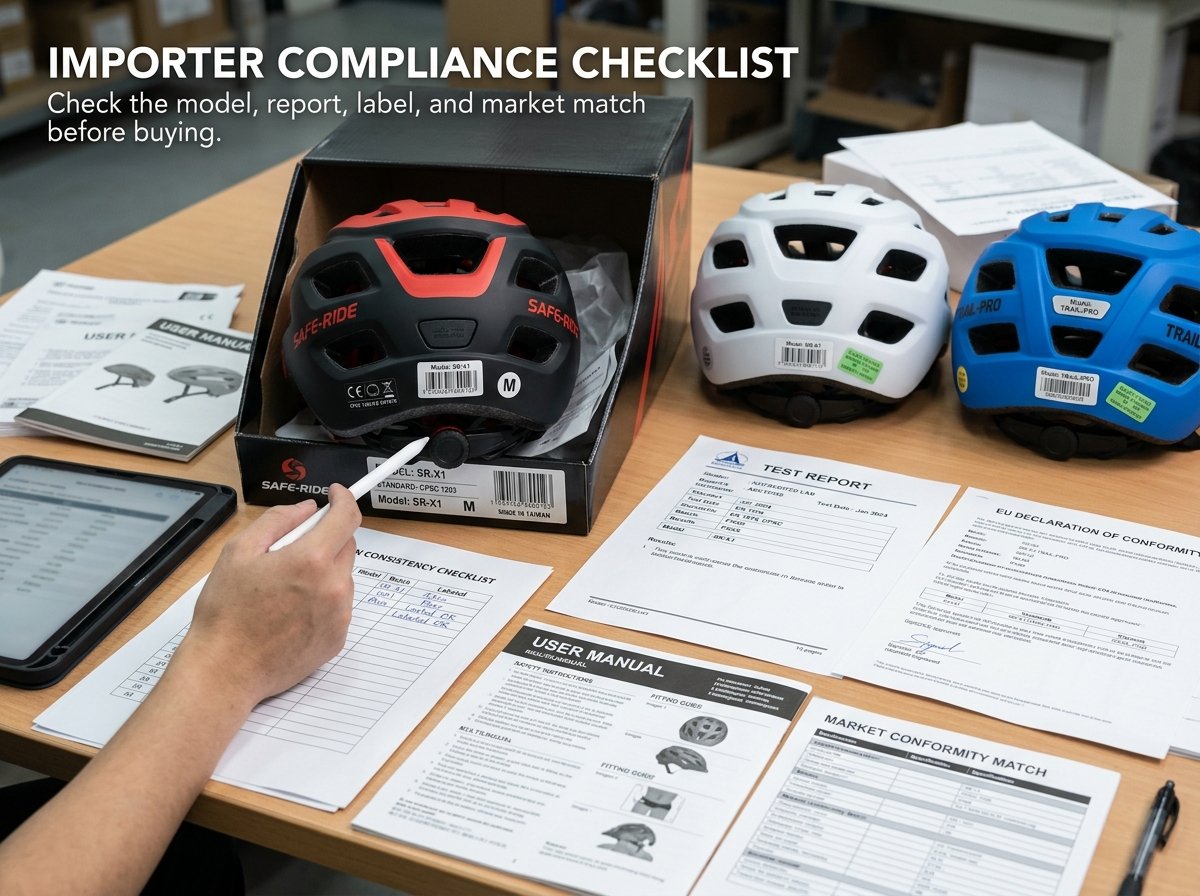
Before buying certified cycle helmets, importers need to confirm the exact standard, the test report scope, the model-to-certificate match, the labeling content, the intended market, and whether mass production stays aligned with the certified sample.
Core compliance checks before order placement
| Check Item | What to Confirm | Why It Matters |
|---|---|---|
| Market target | U.S., EU, Australia, or another destination | The wrong standard can block sales |
| Exact standard name | CPSC 16 CFR Part 1203, EN 1078, AS/NZS 2063, ASTM type | Generic “tested” language is not enough |
| Model identity | Model code, shell version, size range, accessories | The report must match the shipped helmet |
| Labeling and marks | Product mark, batch code, care label, warning text | Missing or wrong labels create customs and retail risk |
| Test report validity | Date, issuing lab, scope, sample description | Outdated or incomplete reports create legal exposure |
| Production consistency | Bulk goods match the tested sample | Sample-good / bulk-bad problems destroy trust |
| Packaging documents | User manual, carton marks, barcode, packing list | Retail and import systems rely on correct data |
The most common sourcing blind spots
The biggest blind spot is assuming the sample tells the full story. In practice, importers should also verify retention system hardware, foam density, shell construction, trim parts, replacement pads, retail packaging, and labeling format. Even a small change can affect whether the mass-production helmet still matches the tested configuration.
The second blind spot is document transparency. Market complaints in helmet channels often show the same frustration: unclear compliance answers, slow responses, missing files, or certificates that do not seem linked to the actual delivered helmet. That is why strong suppliers prepare technical files early and keep them clean. The best factories do not wait for a buyer complaint. They already know which market file, test summary, label set, and carton marks need to move together.
How do regional standards affect product design and market application?
One helmet platform cannot always serve every market equally well. A factory may want to use one shell for many regions, but the final compliance path still affects labeling, accessories, claim language, and sometimes structural choices.
Regional standards affect product design because each target market shapes testing priorities, product claims, and compliance paperwork. They also affect how a helmet is sold, packaged, and presented to retailers and online channels.
One platform, different market outputs
A factory may develop one commuter helmet shell and then prepare different versions for different channels. The U.S. program may focus on CPSC alignment. The European version may be built around EN 1078 route-to-market expectations. Australia may require supply against its mandatory standard framework. For performance lines, ASTM references may support recreational, BMX, or downhill positioning depending on the model. This is not unusual. The important part is controlling version logic clearly.
That means the model matrix should include more than color and size. It should also control market label language, manual content, barcode logic, accessory combinations, and box printing. Public complaints about wrong boxes, wrong labels, and mixed stock show why this matters. Even when the helmet itself is technically acceptable, weak warehouse and packaging control can still turn it into a market problem.
Market application also changes buyer expectations
A premium road helmet buyer may focus on lightweight feel, ventilation, and refined finish. A kids’ helmet buyer may focus on size accuracy, adjustability, and stable retention. A BMX or downhill buyer may care more about use category, structure, and compatibility with riding style. The standard helps define the base category, but the market decides the final buying pressure.
That is why product planning should connect standards with user pain points. Safety is the entry point. Comfort, fit, durability, and communication close the order.
How can a helmet factory support safer and cleaner import decisions?
Importers do not only need a supplier. They need a factory that can reduce uncertainty. In helmets, uncertainty is expensive because the product touches safety, compliance, packaging, and brand reputation at the same time.
A strong helmet factory supports safer buying decisions by linking certification work, design control, production consistency, and export documentation into one process. That is where commercial confidence really comes from.
factory support for certified cycle helmet sourcing
The factory role is bigger than manufacturing
A serious helmet factory should support import projects with structured compliance files, market-specific labels, stable QC, and clear sample-to-bulk control. That includes checking whether the tested helmet version matches the final production BOM, whether replacement liners or accessories change fit, and whether retail packaging still reflects the correct market claims.
This is especially important because helmet review data shows that buyers are highly sensitive to inconsistency. If one batch feels tighter, heavier, louder, or less refined than the approved sample, complaints rise quickly. The same applies to documents. Missing batch traceability, unclear certificates, or export cartons that do not match product labels all create avoidable risk.
Better process leads to stronger long-term sales
The strongest helmet supply relationships are usually built on five things: clear compliance, honest labeling, stable production, fast technical response, and predictable replenishment. These are not marketing extras. They are the working basics that keep certified products moving across markets without friction.
For cycle helmet brands and importers, the best result comes from treating compliance as a full product system. That means safer buying, fewer disputes, and a much stronger base for long-term market growth.
Conclusion
Cycle helmet safety standards are the foundation of legal market access, product credibility, and safer product development. CPSC 16 CFR Part 1203 remains the key mandatory rule for bicycle helmets in the United States. EN 1078 continues to be the main European cycle helmet reference standard. AS/NZS 2063 remains central to Australia and related market applications, while ASTM standards add useful structure for specific riding categories such as recreational cycling, BMX, and downhill mountain biking. :contentReference[oaicite:2]{index=2}
For importers, the most important lesson is simple: certification language alone is never enough. The correct standard, the exact model match, the label set, the packaging details, and the mass-production consistency all need to be checked together. Many market problems start not with a crash, but with a mismatch between the tested sample, the documents, and the final delivered goods.
For helmet factories, the real advantage comes from turning compliance into a controlled system. That means solid engineering, clear document support, stable quality, and product versions that truly match the target market. When that work is done properly, certified cycle helmets become easier to import, easier to sell, and much more trusted in the market.