
Motorcycle helmets are made through a controlled process that combines shell forming, impact liner molding, trimming, painting, assembly, and testing. Each step affects safety, comfort, appearance, consistency, and final cost, which is why manufacturing quality matters as much as helmet design itself.
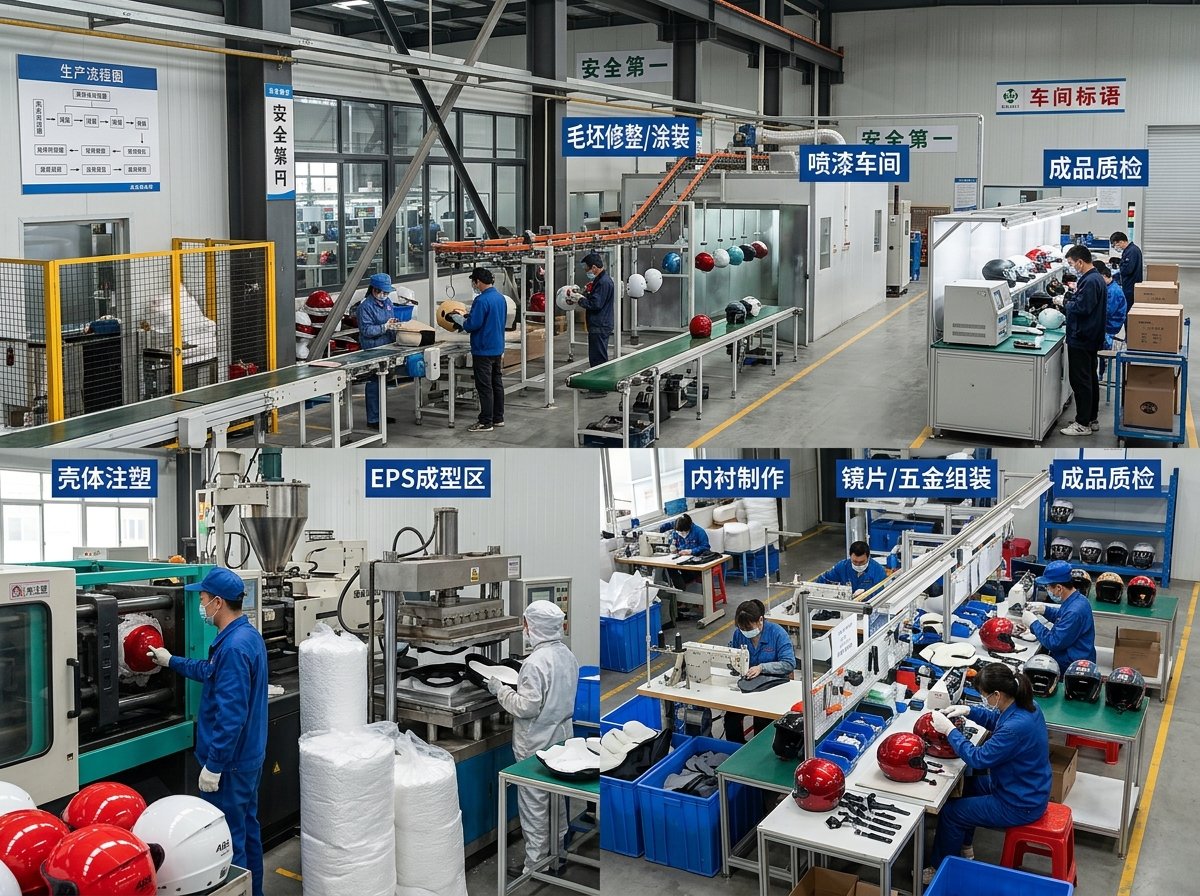
Many buyers look at a finished helmet and only see the outside shell, visor, and graphics. The real product story starts much earlier. It begins with material choice, mold accuracy, shell consistency, EPS energy management, comfort liner fit, and assembly control. Market insights make this point very clear. Positive helmet feedback often focuses on light weight, quietness, comfort, stable fit, and solid build quality. Negative feedback repeats the same problem areas again and again: wind noise, pressure points, fogging, visor leaks, strap discomfort, liner wear, and parts that loosen or fail too early. These issues are rarely random. In most cases, they can be traced back to manufacturing decisions, tolerance control, material selection, and quality checks during production.
Why Does the Manufacturing Process Matter So Much?
The manufacturing process matters because helmet safety and rider comfort depend on much more than the shell material or certification label. A helmet only performs well when every production step is controlled correctly.
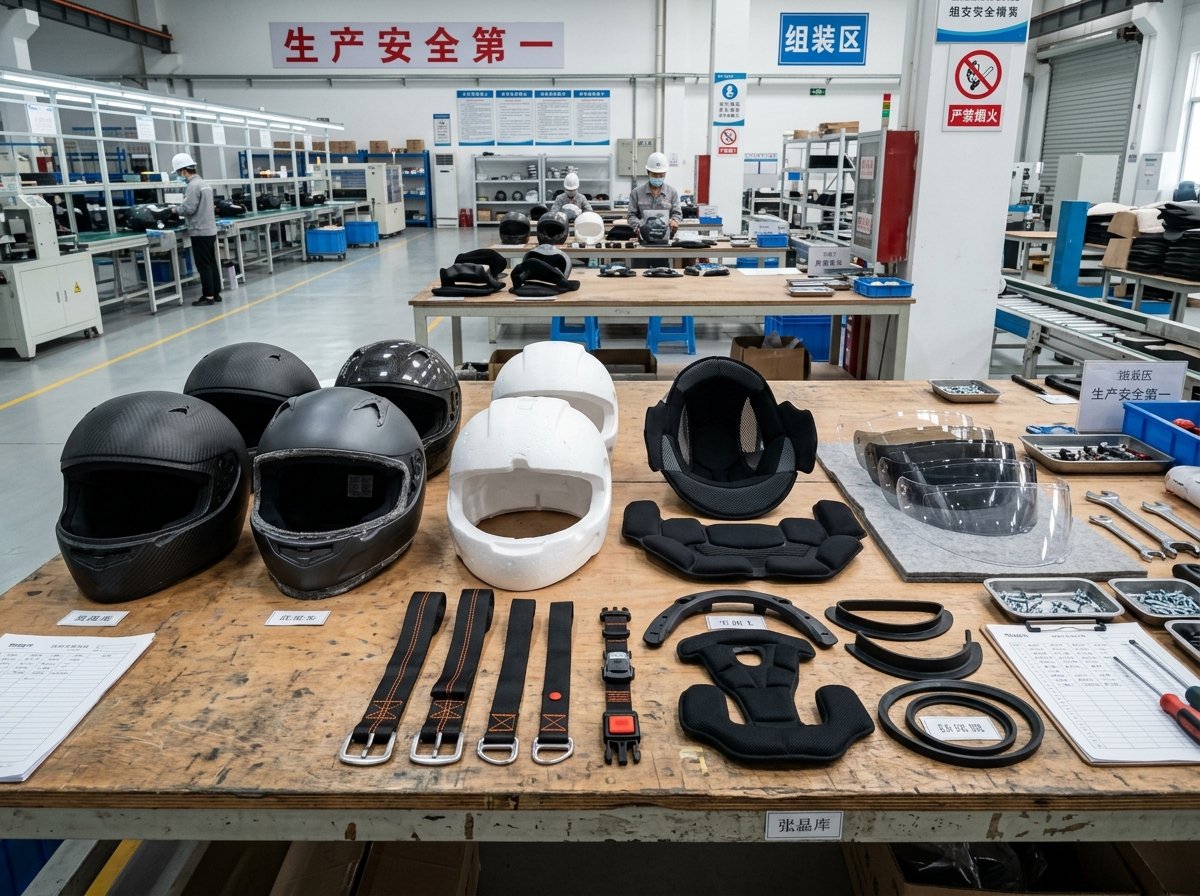
A motorcycle helmet is not one part. It is a complete system. The outer shell manages the first impact contact. The EPS liner absorbs energy. The visor, vents, strap, neck roll, cheek pads, and crown liner all affect real-world experience. If just one area is poorly made, the whole product feels weaker in the market.
This explains why rider complaints often sound highly specific. Some helmets are described as too noisy above certain speeds. Some fog up quickly even with anti-fog parts installed. Some create forehead pain after an hour. Others feel cheap because visor screws loosen, cheek pads collapse, or strap geometry digs into the neck. These are not only design problems. They are also manufacturing problems.
What buyers really feel from manufacturing quality
| Manufacturing result | What the rider notices |
|---|---|
| Tight shell and visor tolerance | Less leakage, less rattling, better quietness |
| Stable EPS and liner fit | Better comfort and more consistent protection feel |
| Controlled trim and strap assembly | Better wear comfort and fewer early failures |
| Accurate painting and finishing | Stronger premium image |
| Reliable final inspection | Fewer defects at delivery |
This is why the production process deserves just as much attention as the final helmet specification.
Step-by-Step Motorcycle Helmet Manufacturing Process Explained for Buyers?
The motorcycle helmet manufacturing process usually includes shell production, EPS molding, trimming, finishing, painting, liner preparation, hardware assembly, and final inspection before packing.
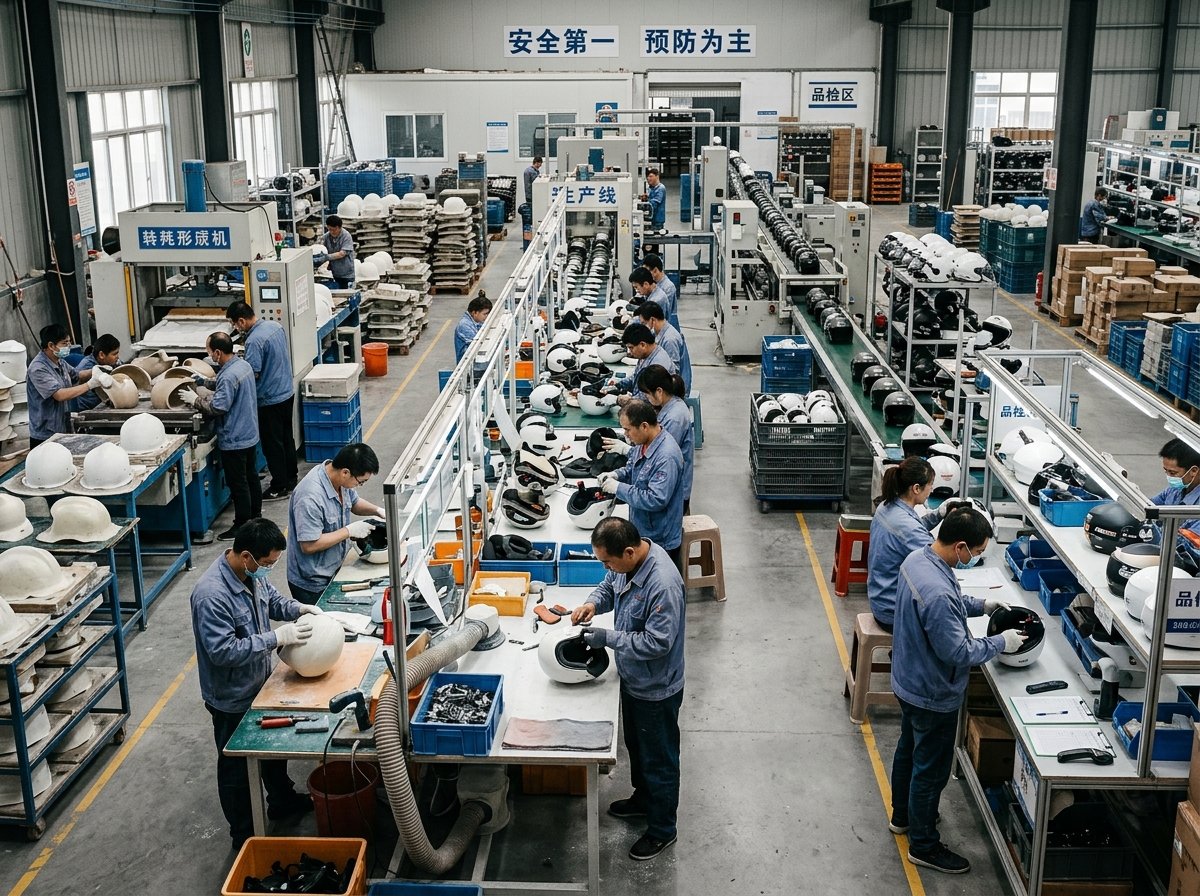
Although exact methods vary by factory and by helmet category, the core production path is usually similar.
1. Product engineering and mold preparation
Every helmet starts with engineering drawings, shell shape development, impact zone planning, and mold creation. At this stage, factories define shell sizes, visor openings, vent layout, strap anchor locations, and liner dimensions. A weak decision here creates problems later. If the shell shape does not match target head profiles, the product may end up with pressure points on the forehead, temples, or cheekbones.
2. Outer shell production
The shell is formed using the chosen material system. Thermoplastic helmets use injection molding. Fiberglass and carbon fiber helmets usually use layered composite construction in molds. The shell is then cured, removed, and checked for basic shape accuracy. This stage strongly affects weight, shell stiffness, shell thickness consistency, and perceived premium quality.
3. EPS liner molding
The EPS liner is molded separately and designed to manage impact energy. This part is one of the most important safety elements in the entire helmet. Different density zones may be used depending on the model. Poor EPS control can hurt both protection consistency and comfort.
4. Trimming and machining
After molding, shell edges, visor openings, vent holes, and hardware locations are trimmed or machined. Precision matters here. If visor hinge areas or vent cutouts are inconsistent, later assembly can create leaks, rattles, or misalignment.
5. Surface preparation and painting
The shell surface is sanded, primed, painted, and sometimes finished with decals or graphics. Premium helmets often depend heavily on paint quality, clear coat depth, and clean edge finishing to justify price.
6. Liner and soft parts production
Cheek pads, crown liners, neck rolls, chin curtains, and strap covers are cut, sewn, filled, and assembled. This stage influences comfort more than many buyers realize. Many market complaints about pain, hot spots, or worn-out padding start here.
7. Hardware and visor assembly
Vents, visor pivots, shields, strap systems, D-rings or buckle systems, and decorative trims are installed. This is one of the most failure-sensitive stages in production.
8. Final inspection and packing
The finished helmet is checked for appearance, function, fit of moving parts, labeling, and accessories before packing.
Key Production Stages and Materials Used in Helmet Manufacturing?
The key production stages depend on the shell material, EPS structure, soft goods, visor system, and hardware, because each material changes both performance and manufacturing complexity.
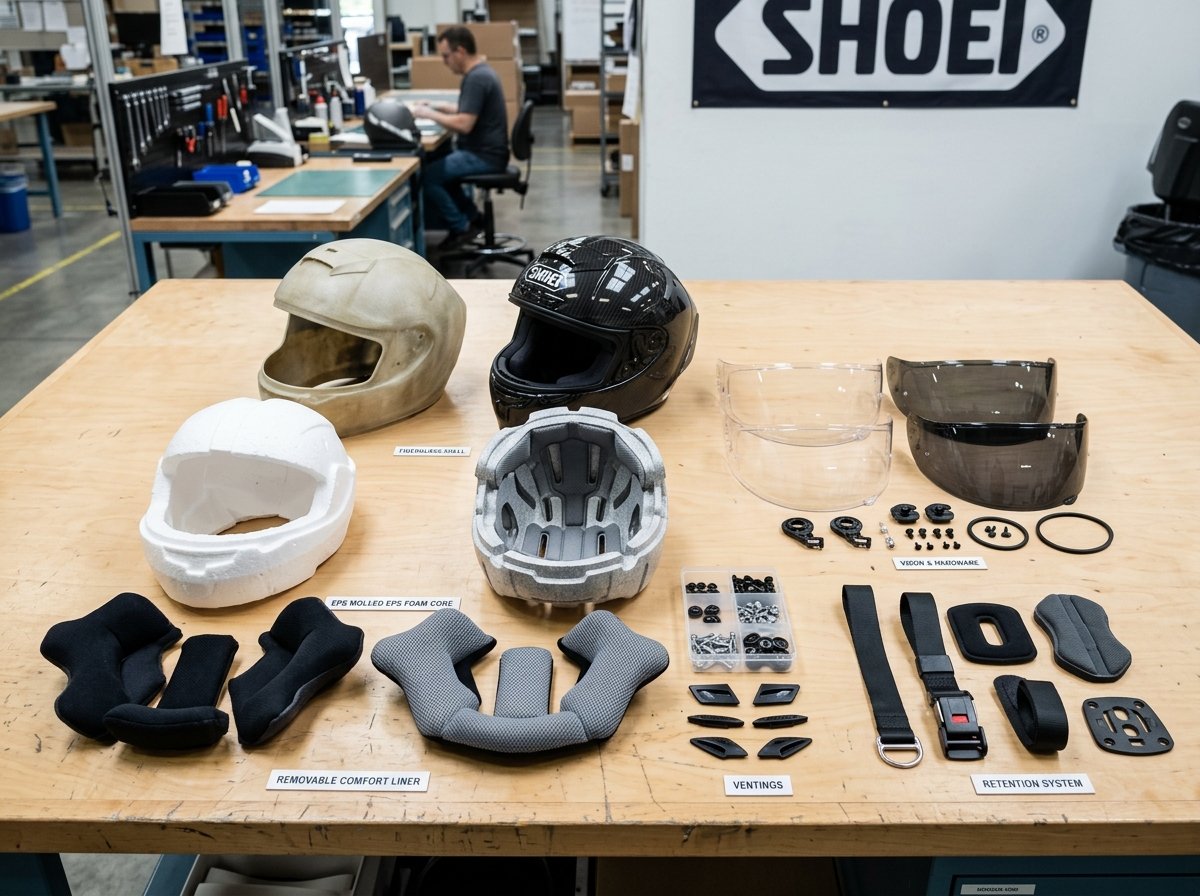
Different helmet categories use different material combinations. These combinations affect price, weight, durability, and market positioning.
Common materials used in helmet production
| Helmet part | Common materials | Why it matters |
|---|---|---|
| Outer shell | Thermoplastic, fiberglass, carbon fiber, composite blends | Affects weight, stiffness, price, premium image |
| Impact liner | EPS | Controls energy absorption |
| Comfort liner | Foam, mesh, moisture-wicking fabric | Affects fit, heat, long-wear comfort |
| Visor | Polycarbonate and coated shield materials | Affects clarity, scratch resistance, anti-fog performance |
| Strap system | Woven straps, D-rings, buckles, stitching materials | Affects security and comfort |
| Trim parts | Rubber edges, vent plastics, pivot covers | Affects durability, sealing, and finish quality |
This matters because riders can feel the result of each material choice. Heavy shells create fatigue. Weak hard-coating leads to scratched visors. Poor foam recovery causes loose fit over time. Low-grade strap materials can create sharp pressure against the throat or neck. In premium helmets, these details become even more important because customer expectations are much higher.
How Manufacturing Methods Impact Helmet Quality and Cost?
Manufacturing methods directly affect helmet quality and cost by changing labor input, material waste, consistency, finishing quality, and the amount of control needed at each step.
Not all helmets are produced the same way. Injection-molded shells are efficient for volume production and lower cost segments. Composite shells such as fiberglass and carbon fiber require more manual work, more curing control, more finishing labor, and usually more detailed inspection. That raises production cost, but it can also support better weight control and stronger premium positioning.
The manufacturing method also affects consistency risk. In theory, a premium material sounds better. In practice, poor layup control, inaccurate trimming, or weak assembly can ruin the advantage. This is why some expensive helmets still receive complaints about wind noise, pressure points, visor leaks, and poor durability. Premium materials cannot rescue weak manufacturing discipline.
Manufacturing method comparison
| Method | Usual benefit | Main trade-off |
|---|---|---|
| Injection molding | Lower cost, high volume repeatability | Less premium material image |
| Fiberglass layup | Strong value-performance balance | More labor and finishing work |
| Carbon fiber layup | Lightweight premium positioning | Highest process cost and tighter QC demand |
| Multi-part modular assembly | Added convenience and feature value | More moving-part failure risk |
For commercial buyers, this means a higher-cost helmet should not only look better on paper. It should show real gains in weight, comfort, finish, consistency, and long-term reliability.
What Happens During Assembly and Why Is It So Important?
Assembly is the stage where shell, EPS, visor, liners, straps, vents, and trim parts finally become one finished helmet, so mistakes here can quickly turn a good design into a weak market product.
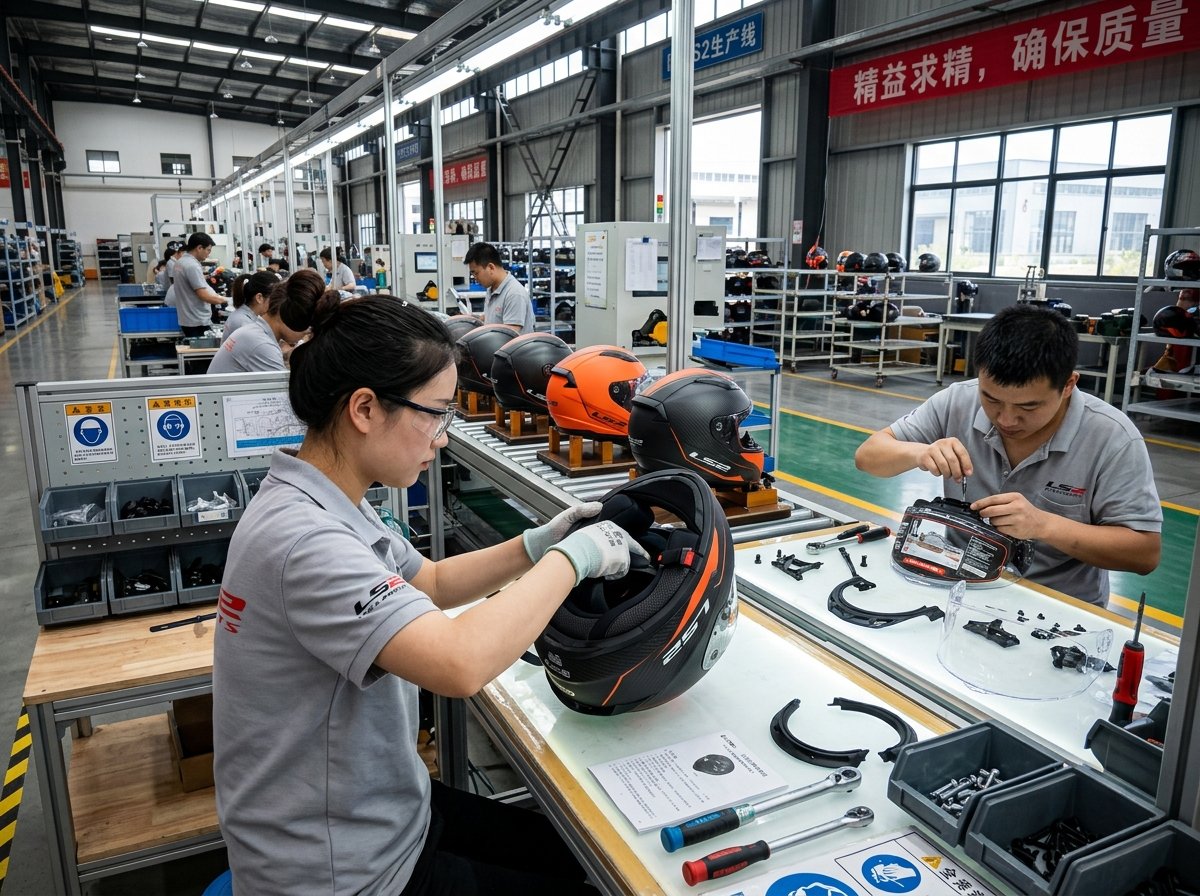
Assembly is where many of the most common market complaints are either prevented or created. If the visor gasket is not seated correctly, the helmet may leak in rain or produce excess wind noise. If the chin strap anchor angle is wrong, the strap may dig into the rider’s throat. If liner buttons are weak, the padding may detach during normal removal. If vent gates do not seal properly, cold-weather leakage becomes a real complaint.
This stage is especially important because riders directly feel assembly quality every day.
Common assembly-sensitive problem areas
| Problem seen in reviews | Likely assembly or process cause |
|---|---|
| Visor leaks in rain | Gasket fit or hinge tolerance issue |
| Helmet too noisy | Neck roll gap, visor fit, vent sealing, trim alignment |
| Strap digs into neck | Poor anchor point angle or strap routing |
| Pads come loose | Weak snap fixation or poor base material |
| Sun visor jams | Rail tolerance or switch assembly problem |
Strong assembly control protects both product quality and brand reputation.
How Do Testing and Inspection Shape the Final Helmet?
Testing and inspection shape the final helmet by catching defects before shipment and by proving that the production line can deliver more than just a good sample.
A helmet should never be judged only by its approved prototype. Real market performance depends on whether the bulk production helmets match the tested version. This is one of the biggest concerns in commercial sourcing. Buyers worry that the sample feels solid, but the mass-production version may change in paint quality, liner feel, visor fit, or trim durability.
Inspection helps control that risk. A serious helmet factory should not only check cosmetics. It should also check moving parts, strap strength, visor action, vent function, label accuracy, accessory completeness, and packaging protection. Beyond that, deeper validation can include wear-cycle tests, visor opening tests, high-low temperature checks, humidity aging, and repeated liner removal tests.
Final checks that matter most
| Inspection area | Why it matters |
|---|---|
| Shell surface and paint | Protects premium appearance and delivery satisfaction |
| Visor alignment and seal | Prevents leakage, noise, and customer complaints |
| Strap and buckle function | Critical for safety confidence |
| Padding retention and fit | Prevents early wear complaints |
| Packaging integrity | Protects the product during shipping |
A factory that invests in strong final inspection usually reduces return rates, warranty disputes, and channel complaints.
Which Manufacturing Details Most Affect Market Feedback?
The manufacturing details that most affect market feedback are fit consistency, visor quality, wind-noise control, liner durability, strap comfort, and the reliability of moving parts.
The supplied market insights point to a very clear pattern. Riders praise helmets that are lightweight, comfortable, quiet, stable, well ventilated, and well built. They criticize helmets that are loud, heavy, painful, hot, scratch-prone, fog-prone, or weak in long-term durability. These reactions are strongly tied to factory execution.
A shell that is a few millimeters off in critical sealing areas can create noise complaints. A liner that looks soft in the sample room but loses shape after use can destroy repeat purchase trust. A visor coating that performs poorly in wiping tests becomes a scratch complaint quickly. Even a good safety platform can lose market strength if everyday quality feels careless.
Manufacturing priorities that create stronger reviews
| Priority area | Market result |
|---|---|
| Better head-shape development | Fewer pressure-point complaints |
| Strong visor hard-coating and sealing | Better clarity and fewer fog/leak complaints |
| Improved neck roll and trim control | Lower noise complaints |
| Higher liner durability | Better long-term comfort reputation |
| More reliable hardware | Fewer failures and warranty issues |
This is where manufacturing becomes a market strategy, not just a factory process.
Conclusion
Motorcycle helmets are made through a sequence of tightly connected production steps, and each one leaves a clear mark on the final product. Shell forming, EPS molding, trimming, painting, liner construction, hardware installation, and final inspection all shape the helmet’s safety, comfort, finish quality, and service life. A strong result does not come from one premium material or one good-looking sample. It comes from consistent process control from the first mold to the final carton.
This is also why market feedback is so useful when looking at helmet manufacturing. Riders may not describe problems using factory terms, but their complaints reveal the process weaknesses very clearly. Wind noise points to sealing, aero tuning, or trim control. Pressure points point to shell shape, EPS, or liner execution. Fogging points to visor design, vent flow, and tolerance management. Loose pads, failed straps, scratched visors, and weak moving parts all point back to production discipline.
For buyers and product planners, the most important lesson is simple. A well-made helmet is not defined only by the material name or certification claim on the label. It is defined by how carefully the factory controls every stage, how consistently the bulk product matches the approved sample, and how well the final helmet performs in the rider’s daily experience. In the helmet market, manufacturing quality is not hidden in the background. It is the reason some products win trust quickly while others lose it just as fast.