A strong helmet factory laboratory should do more than prepare products for outside certification. It should help verify impact performance, retention reliability, material stability, fit consistency, and batch repeatability before problems reach the market. For OEM buyers, laboratory capability is one of the clearest signs of whether a factory can control both product safety and production quality.
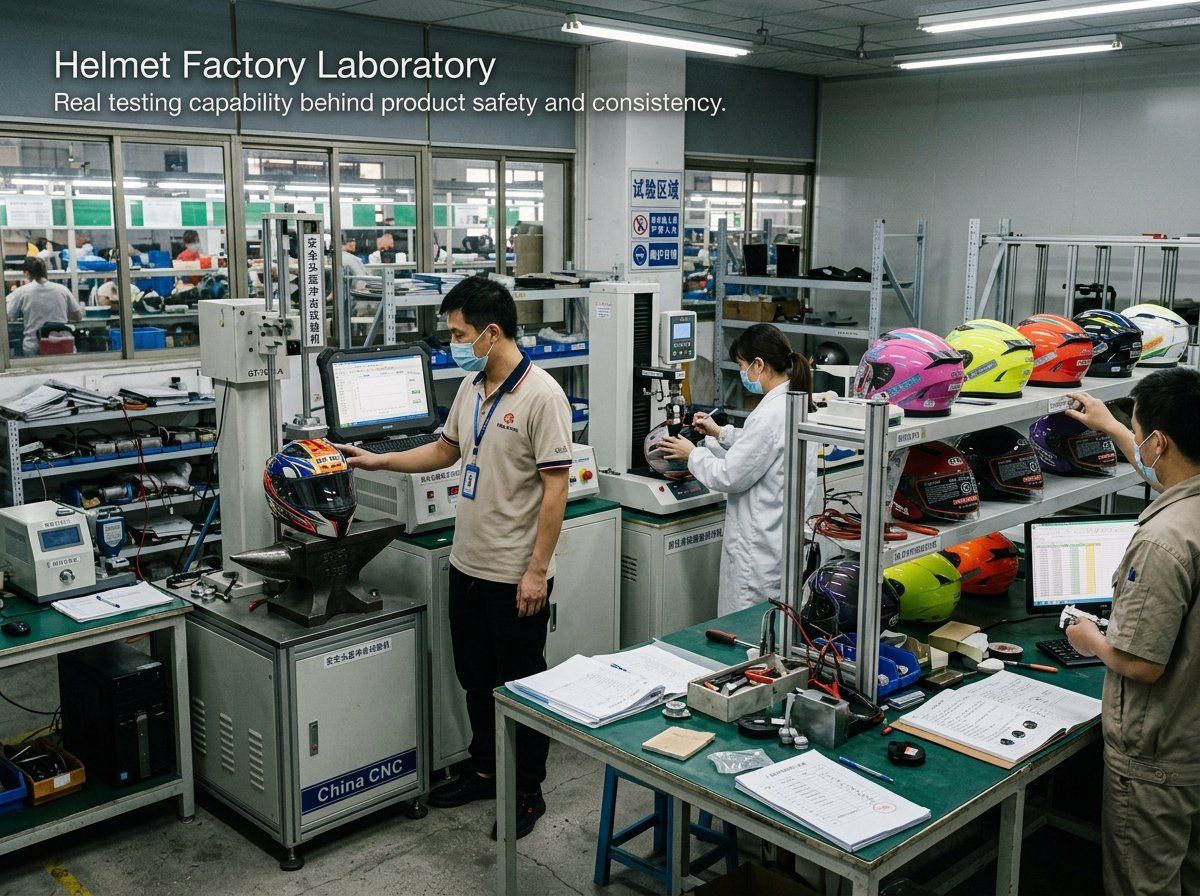
In the helmet industry, laboratory capability matters because buyers are not only purchasing a sample. They are purchasing the factory’s ability to repeat that sample in real production. This is where many suppliers succeed or fail. A helmet may look strong in photos and still create problems later through unstable fit, weak strap performance, poor visor durability, inconsistent liner quality, or batch-to-batch variation. The market patterns behind helmet reviews make this very clear. Positive feedback usually goes to products that feel comfortable, stable, lightweight, well built, and reliable over time. Negative feedback usually targets pressure points, wind noise, fogging, weak parts, poor fit consistency, and disappointing durability. That is why a serious laboratory matters. It helps a helmet factory catch problems earlier, improve development speed, and protect the buyer from sample-to-bulk quality drift.
Why Do Helmet Factory Laboratory Capabilities Matter So Much?
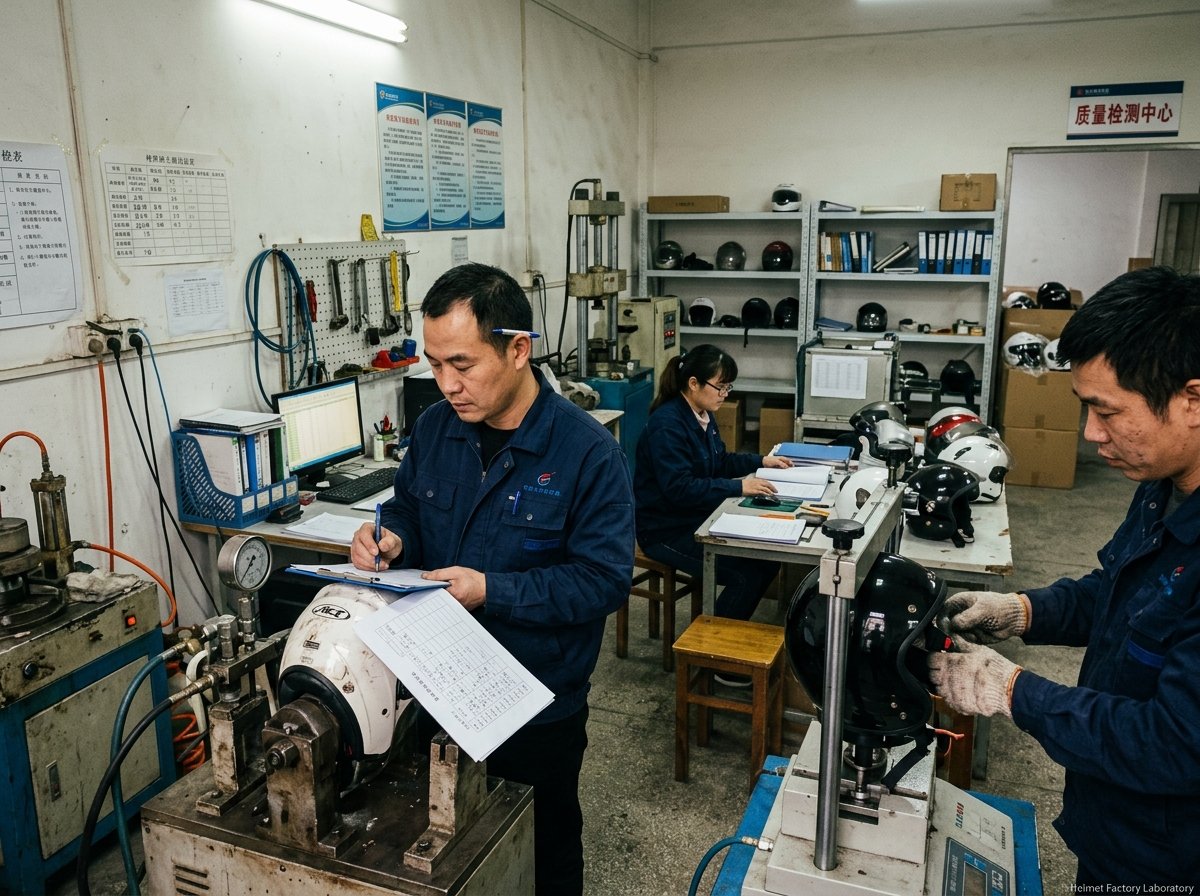
A helmet is a complex protective product. The shell, impact liner, retention system, comfort parts, visor or accessory components, and final assembly all affect how the product performs and how it feels in use. Even small changes in material density, molding quality, strap assembly, or component fit can affect both safety performance and market acceptance.
Without meaningful lab capability, a factory often depends too heavily on last-stage outside testing. That creates a slower development cycle and a higher chance of discovering problems too late. A stronger factory uses its lab much earlier. It screens designs before formal submission, checks material behavior before mass production, and verifies whether production helmets remain aligned with approved samples. For buyers, this means fewer surprises, lower rework risk, and more confidence that the product line can scale.
Key Laboratory Tests Helmet Factories Should Be Able to Perform In-House?
The most important in-house laboratory tests are impact checks, retention-system tests, positional stability checks, environmental conditioning, and critical component durability testing.
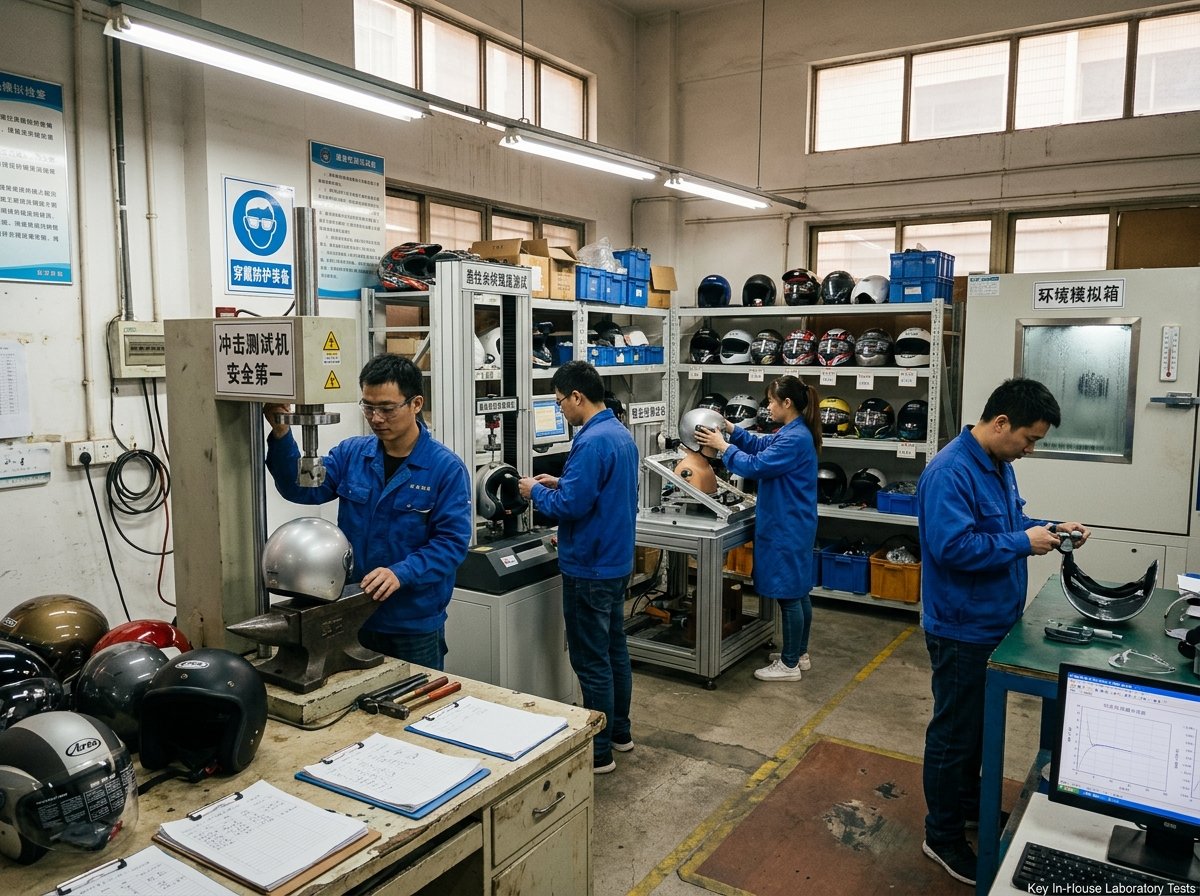
A helmet factory does not need to replace every third-party lab function, but it should be able to perform core internal tests that support product development and quality assurance. These tests help the factory find risks earlier and reduce the chance of costly failures later.
Core in-house laboratory capabilities
| Test capability | Why it matters |
|---|---|
| Impact testing | Checks basic energy-management performance |
| Retention-system strength testing | Verifies strap and buckle or D-ring integrity |
| Positional stability checks | Helps confirm secure helmet placement during use |
| Environmental conditioning | Shows how heat, cold, or humidity affect the product |
| Component durability testing | Protects fit systems, pads, visors, vents, and hardware |
| Weight and dimensional verification | Supports consistency across sizes and batches |
These capabilities matter across many helmet categories because buyers want more than a certificate. They want a product that stays consistent in real use and real shipment conditions.
Which In-House Tests Create the Most Value During Development?
The highest-value in-house tests are the ones that help a factory check impact direction, retention performance, fit stability, and early production repeatability before formal outside submission.
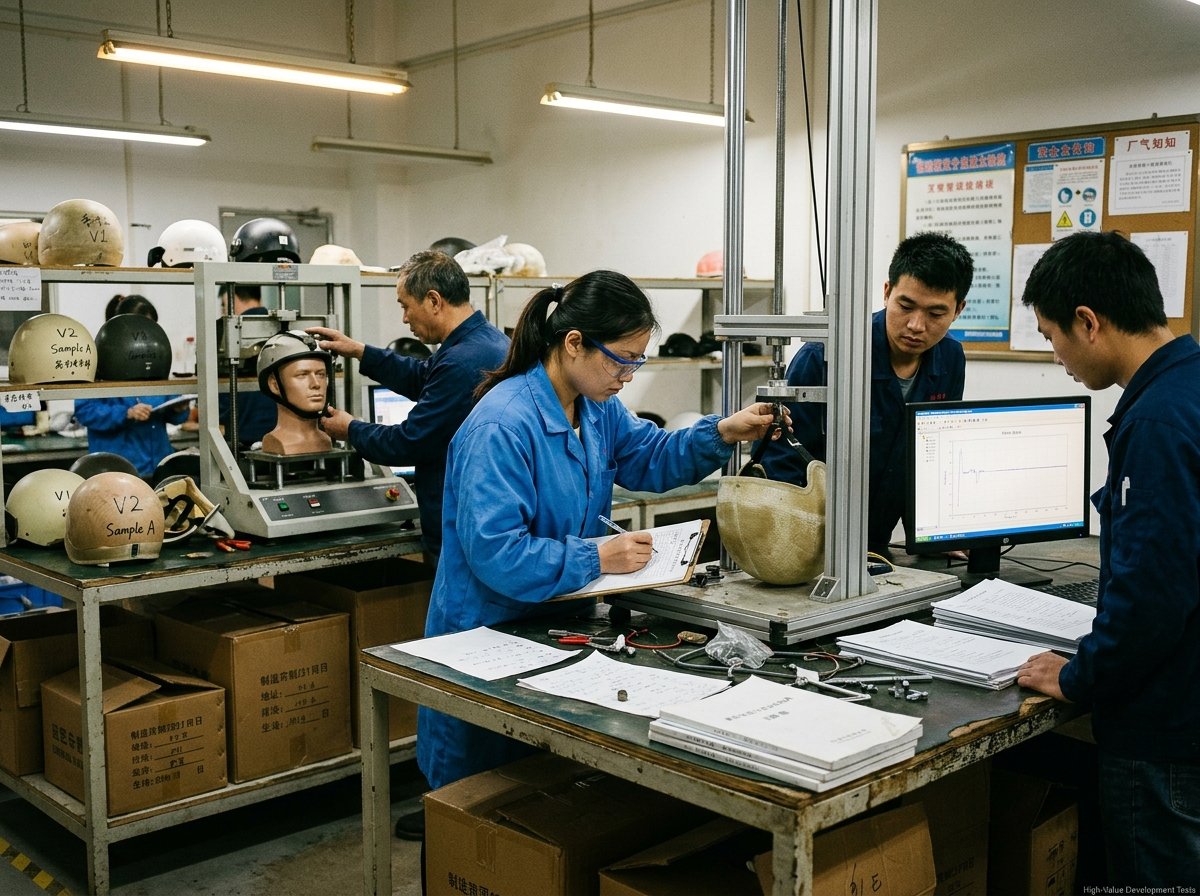
During development, speed and clarity matter. A supplier may adjust shell shape, liner structure, fit components, visor systems, strap details, or accessory layouts several times before the product is truly ready. If every technical question must wait for an outside lab, the project slows down and weak design paths stay alive for too long.
The most valuable internal tests are the ones that answer the most practical questions early. Is the helmet moving in the right impact-performance direction? Is the retention system stable? Does the product shift after environmental exposure? Are fit changes creating new pressure or stability risks? These are the tests that shorten development cycles and improve communication between engineering, production, and quality teams.
Development-stage test priorities
| Development need | Most useful in-house test |
|---|---|
| Early product screening | Basic impact checks |
| Retention validation | Strap and fastening tests |
| Fit stability review | Positional stability checks |
| Material response to climate | Environmental conditioning |
| Everyday use reliability | Component cycling and durability tests |
Factories that use these tests well usually have fewer late-stage redesigns and fewer certification surprises.
In-House vs Third-Party Helmet Testing: What OEM Buyers Should Evaluate?
OEM buyers should evaluate how in-house testing improves speed and control, while third-party testing provides formal certification support, independent validation, and market-entry confidence.
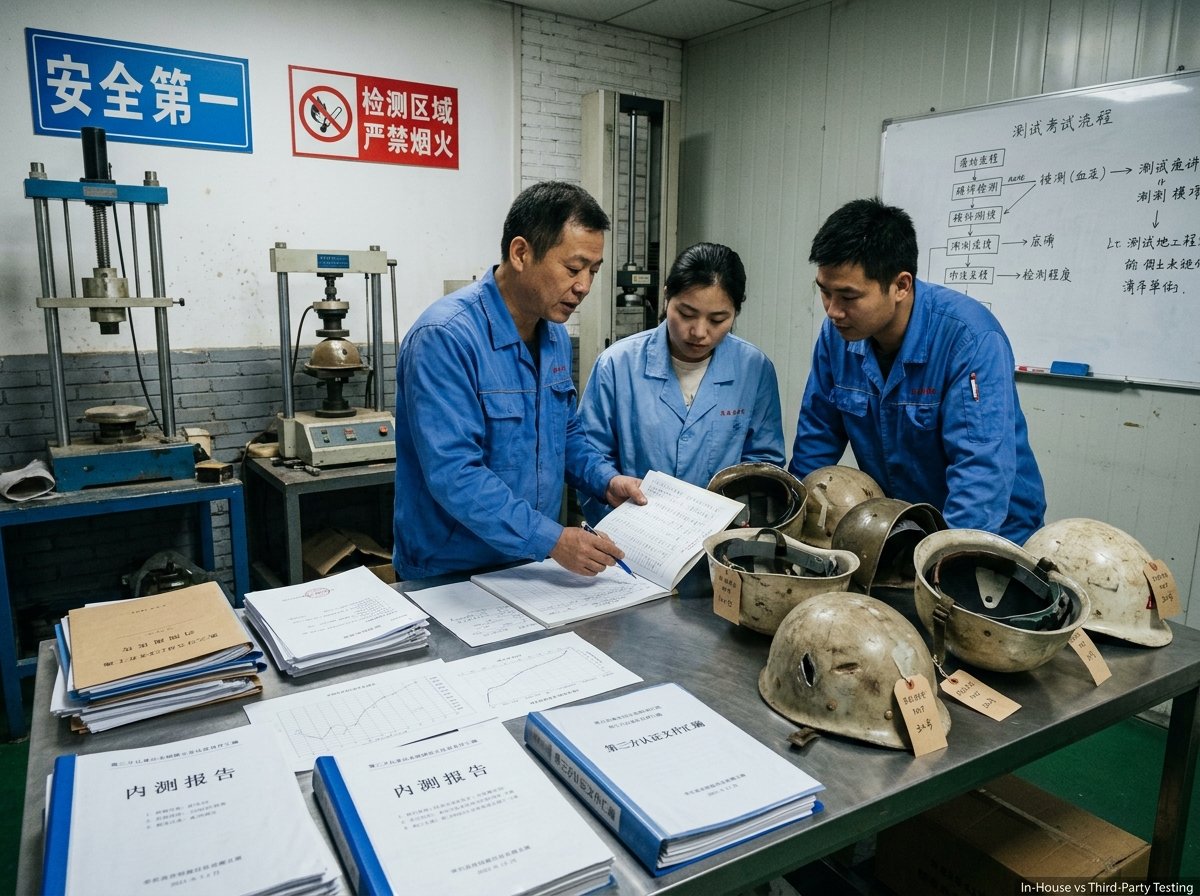
In-house and third-party testing should not be treated as substitutes. They serve different roles. In-house testing is strongest when used for design screening, material comparison, process validation, and production monitoring. It helps the factory identify weaknesses before they become expensive or public.
Third-party testing serves a different purpose. It provides independent verification against the target market standard and gives buyers confidence that the product is ready for compliance-based sales channels. This matters especially in export projects, where documentation and outside validation are often required before launch.
Role comparison
| Testing route | Main value |
|---|---|
| In-house testing | Faster iteration, internal control, earlier problem detection |
| Third-party testing | Formal certification, independent proof, buyer confidence |
For OEM buyers, the strongest suppliers are usually the ones that use both correctly. They do not rely only on outside labs at the last moment, and they do not rely only on internal claims without independent confirmation.
What Should OEM Buyers Look For in a Factory’s In-House Lab?
OEM buyers should look for relevant test coverage, usable records, repeated sample checks, support for different models or sizes, and a clear link between lab results and production decisions.
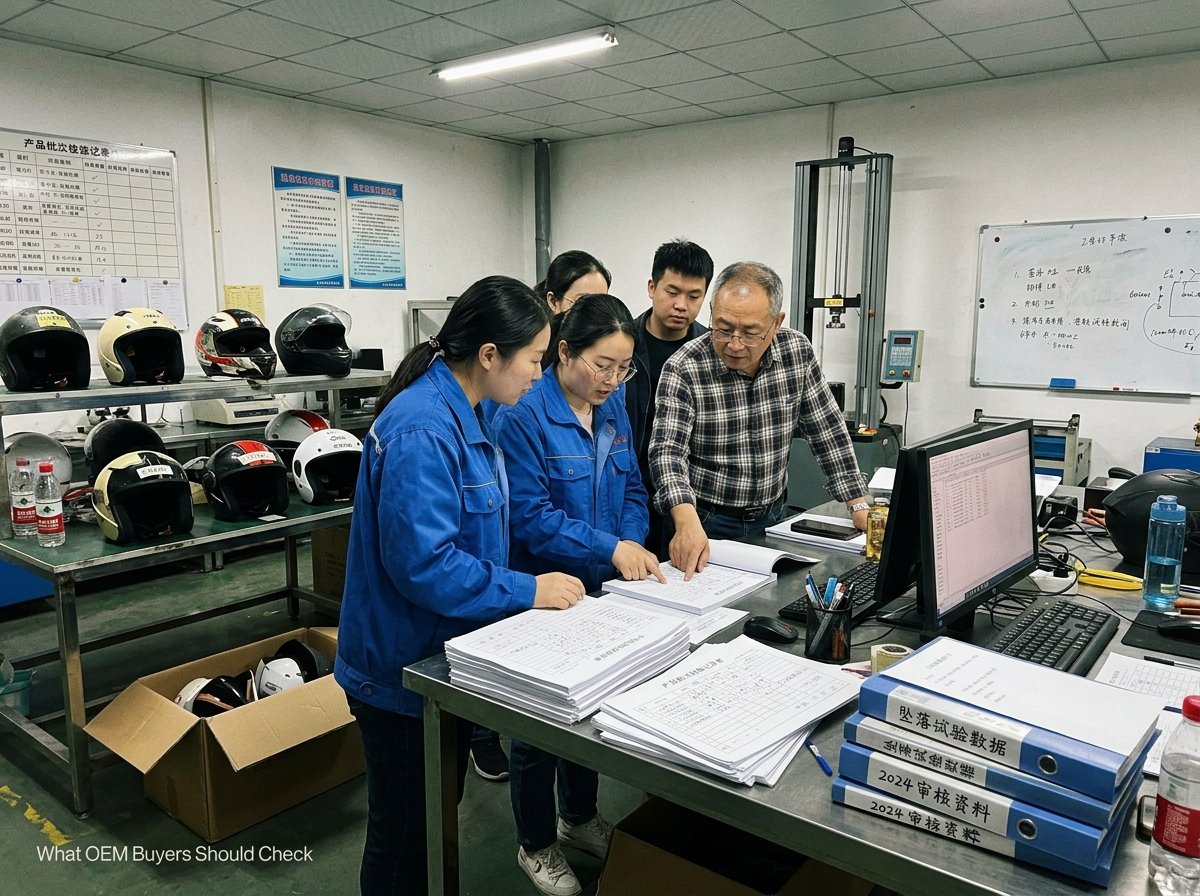
A supplier may say it has a laboratory, but the real question is whether that lab actively improves product quality. A useful lab does not just exist for customer tours. It supports real engineering work and real production control.
Buyers should check whether the factory runs tests on development samples, keeps records by model and batch, compares approved samples with production goods, and uses internal failures to trigger corrections. It is also useful to know whether the factory can test across different shell sizes, trims, and configurations, because many hidden problems only appear when the range expands.
Useful buyer questions
| Question | Why it matters |
|---|---|
| What tests are run internally on each model? | Shows real lab scope |
| Are results tracked by model and batch? | Supports traceability |
| Are production samples rechecked after approval? | Reduces sample-to-bulk drift |
| Can multiple sizes or variants be compared? | Helps control range consistency |
| How are failed internal results handled? | Reveals process maturity |
A stronger lab usually shows discipline, not just equipment.
How Laboratory Testing Capabilities Support Helmet Certification and Quality Control?
Laboratory testing supports certification by helping the factory prepare products that are ready for formal approval, and it supports quality control by helping the factory keep production aligned with the approved standard.
how laboratory testing supports helmet certification and quality control
Certification and quality control are closely related, but they are not the same. Certification confirms that a helmet model can meet the required technical standard under formal test conditions. Quality control checks whether the bulk production helmets continue to match that approved level.
This difference matters because many sourcing problems do not come from missing certification. They come from inconsistency after certification. A sample may pass, but the shipment may later drift in shell feel, liner density, strap performance, visor fit, or hardware reliability. A good laboratory program helps reduce that risk. Before outside submission, it improves readiness. After approval, it helps verify that mass production remains stable.
Testing support through the project cycle
| Project phase | Laboratory value |
|---|---|
| Design and engineering | Screens weak concepts early |
| Pre-certification | Improves formal submission readiness |
| Pilot production | Confirms alignment with approved samples |
| Ongoing quality control | Detects drift in material or assembly performance |
A strong factory uses testing as a continuous control tool, not as a one-time event.
Which Laboratory Capabilities Help Prevent Market Complaints Later?
The most useful capabilities for preventing later complaints are environmental testing, component durability checks, fit-system validation, and batch comparison testing between approved samples and production goods.
Many helmet complaints come from issues that do not always appear in a simple pass-or-fail approval event. Products may still pass the required standard and later disappoint users through poor component life, fit degradation, hardware looseness, visor wear, or changing comfort feel. These are the issues that damage repeat business.
A stronger laboratory helps reduce this risk by checking more than the minimum. It reviews how the product behaves after heat, cold, humidity, repeated wearing, repeated opening and closing, or repeated adjustment. This is important because end users judge the whole helmet experience, not only the initial test result.
Capabilities that help reduce future complaints
| Risk area | Helpful lab capability |
|---|---|
| Fit becomes unstable over time | Fit-system and retention durability checks |
| Comfort declines after repeated use | Pad and liner durability review |
| Shipping or storage changes product feel | Environmental conditioning |
| Bulk goods do not match approved sample | Batch comparison testing |
| Model range behaves inconsistently | Dimensional and configuration verification |
These capabilities protect both the factory and the buyer from hidden quality drift.
What Separates a Strong Helmet Factory Lab from a Basic One?
A strong helmet factory lab supports development, certification readiness, and production control, while a basic lab only performs limited checks without clearly improving the final product.
The strongest labs usually do three things well. First, they test early enough to influence design. Second, they test often enough to control production. Third, they keep usable records and connect results to action. A basic lab may have some equipment, but if it does not support these functions, it adds little real value.
For OEM buyers, this difference is important because the lab reveals how the factory thinks. A mature supplier sees testing as part of engineering and prevention. A weaker supplier sees testing as a last-step requirement linked only to customer requests.
Signs of a stronger lab program
| Strong-lab sign | What it suggests |
|---|---|
| Internal screening during development | Better design control |
| Repeated checks during pilot and bulk production | Stronger consistency discipline |
| Traceable records by model and batch | Better issue management |
| Clear link between test results and corrective action | More practical quality control |
| Support for certification preparation | Better project readiness |
In helmet sourcing, that difference affects launch timing, complaint rates, and long-term trust.
Conclusion
Understanding a helmet factory’s laboratory testing capability is one of the best ways to judge whether the supplier can support a serious OEM program. A strong lab helps the factory do much more than prepare for third-party certification. It helps screen designs earlier, improve development speed, control production variation, and reduce the risk that approved samples and shipped orders will perform differently.
For OEM buyers, the key question is not simply whether the factory has testing equipment. The real question is whether the factory uses laboratory testing to support engineering, improve readiness for formal approval, and maintain quality after mass production begins. Impact checks, retention testing, stability checks, environmental conditioning, and component durability reviews all play a role in that system.
The strongest helmet factories usually combine in-house testing and third-party testing in the right way. In-house testing creates speed, better problem-solving, and tighter internal control. Third-party testing creates independent confirmation and stronger market confidence. When both systems work together, buyers get a more reliable product, a more stable certification path, and better protection against the small but costly quality failures that can damage a helmet program after launch.