Helmet quality control is the process that checks whether a motorcycle helmet is safe, consistent, and ready for shipment. For bulk buyers, strong quality control reduces the risk of returns, warranty claims, delayed launches, retailer complaints, and loss of trust caused by sample-to-bulk inconsistency.
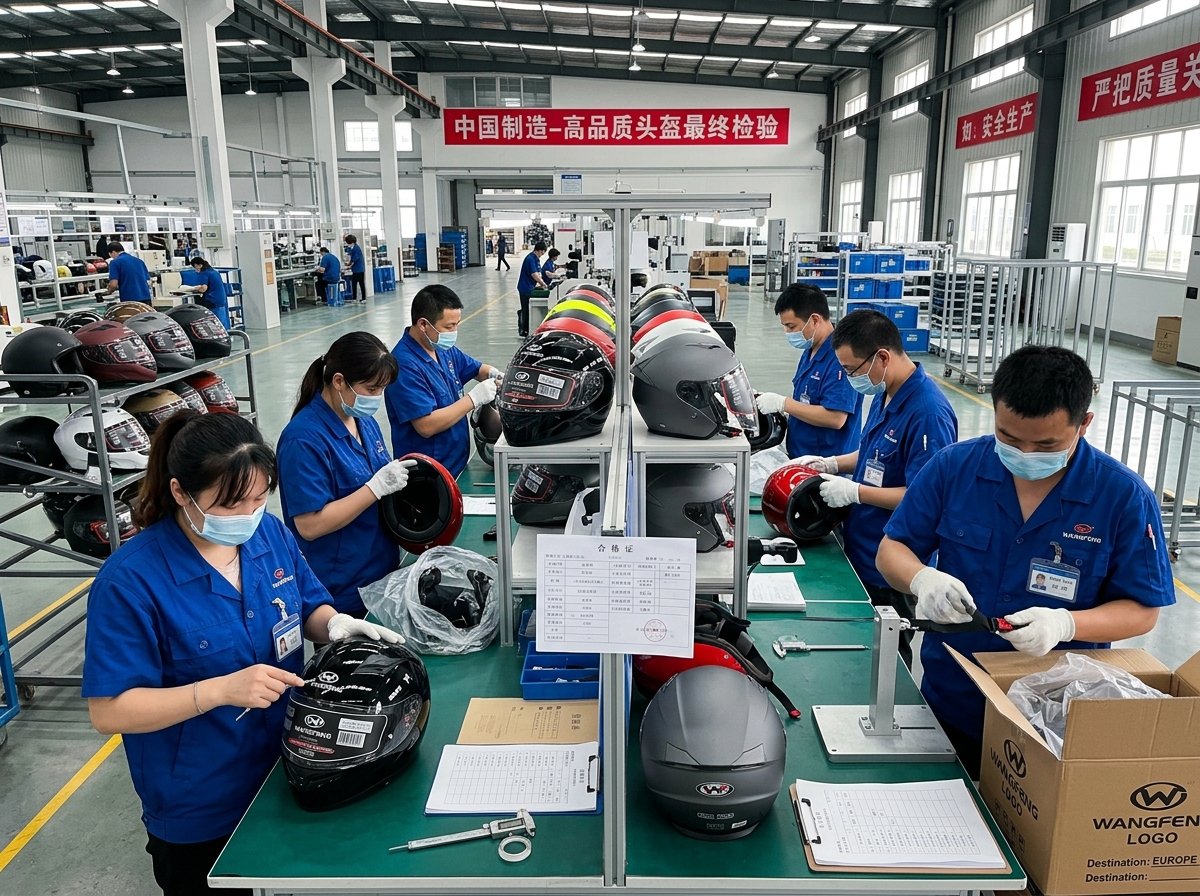
In the helmet market, quality problems are rarely hidden for long. Riders notice them fast. Market feedback repeatedly shows the same pain points: wind noise, visor fogging, poor fit, pressure points, strap discomfort, liner wear, loose parts, scratched visors, and failures in moving components. On the positive side, strong reviews usually focus on comfort, quietness, stable fit, good ventilation, light weight, and durable construction. This makes quality control more than a factory routine. It is a direct driver of product reputation and repeat business.
A buyer may receive a good-looking sample and still face trouble later if the bulk shipment does not match it. That is why helmet sourcing should never stop at design approval or certification papers. The real question is whether the factory can produce the same standard every time, across every batch, every size, and every shipment.
Why Is Quality Control So Important in Motorcycle Helmet Buying?
Quality control matters because a helmet is judged not only by safety claims, but also by daily use, long-term comfort, and consistency from one unit to the next.
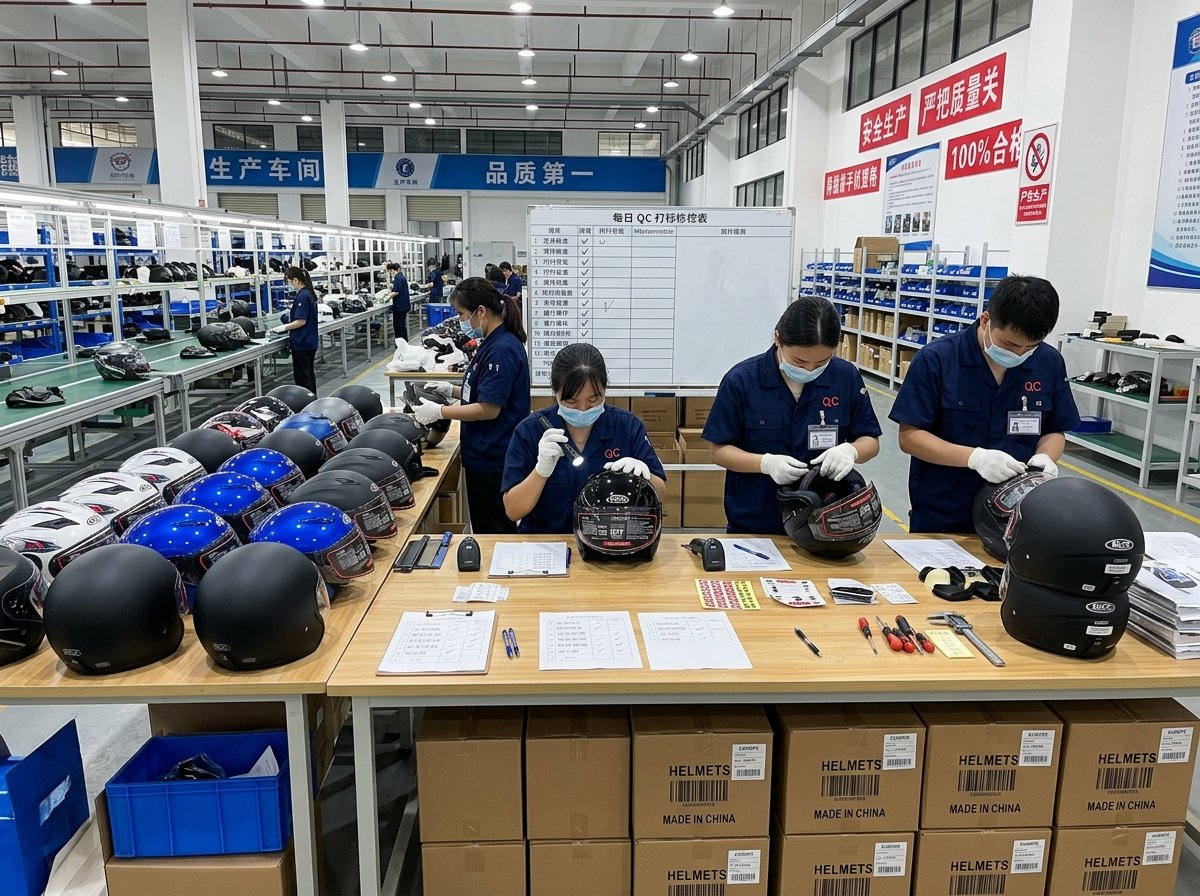
Many of the most common complaints in the helmet market come from weak control over details that riders feel immediately. A visor that leaks in rain. A strap that digs into the throat. Cheek pads that lose tension too fast. A sun visor that jams. A shell that looks fine outside but feels noisy and unstable at speed. These are not small issues. They are the exact problems that damage retail reviews, increase after-sales cost, and make distributors hesitate on repeat orders.
Quality control is also important because helmets are highly sensitive to inconsistency. A minor change in visor seal, liner density, strap routing, or vent fit can create visible differences in user experience. In a safety product, that risk is even more serious. Buyers need confidence that the bulk order is not only certified, but also assembled, finished, and packed to the same standard as the approved sample.
What weak QC usually leads to
| QC weakness | Market result |
|---|---|
| Poor visor fit control | Wind noise, leaks, fog complaints |
| Inconsistent liner density | Pressure points, headache complaints |
| Weak trim and hardware checks | Loose parts, early failures |
| Poor strap inspection | Discomfort, customer safety concerns |
| Weak final inspection | More returns and retailer disputes |
Good quality control protects both the product and the brand behind it.
Motorcycle Helmet Quality Control Checklist for Bulk Buyers?
A strong quality control checklist should cover shell quality, EPS fit, liners, straps, visor systems, ventilation parts, labeling, packaging, and sample-to-bulk consistency before shipment.
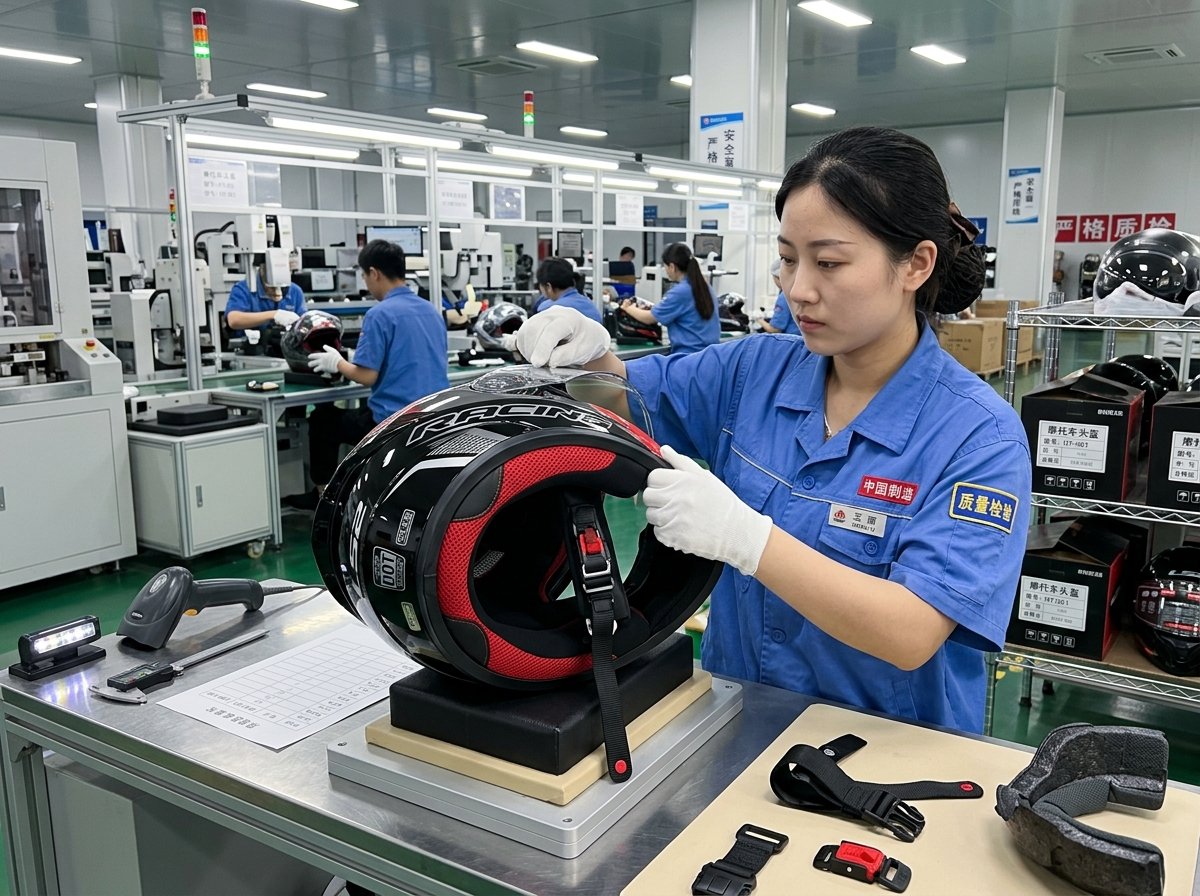
A bulk buyer needs a checklist that goes beyond general appearance. The helmet may look acceptable in the carton, yet still hide problems that appear later in the market. A practical checklist should focus on the areas most likely to create real complaints.
Basic QC checklist for helmet orders
| Inspection area | What to check |
|---|---|
| Shell surface | Scratches, sink marks, paint defects, uneven finish |
| Shell shape and size | Correct shell size, correct model form, no distortion |
| EPS liner | Proper fit inside shell, no gaps, no breakage |
| Cheek pads and crown liner | Density consistency, clean stitching, firm attachment |
| Strap system | Stitching strength, anchor angle, buckle or D-ring function |
| Visor system | Smooth opening, locking feel, seal contact, visual clarity |
| Vent parts | Proper fit, opening and closing action, no looseness |
| Trim and rubber edges | Firm attachment, no lifting, clean finish |
| Labels and markings | Correct certification marks, size labels, barcode accuracy |
| Packaging | Correct accessories, visor protection, clean box condition |
This checklist should always be used against the approved golden sample, not against memory or general expectations. In helmet sourcing, the golden sample is the safest benchmark.
What Are the Most Important Inspection Points Before Shipment?
The most important points before shipment are fit consistency, visor function, strap reliability, liner durability, finish quality, and packaging accuracy, because these are the areas riders notice first and complain about most often.
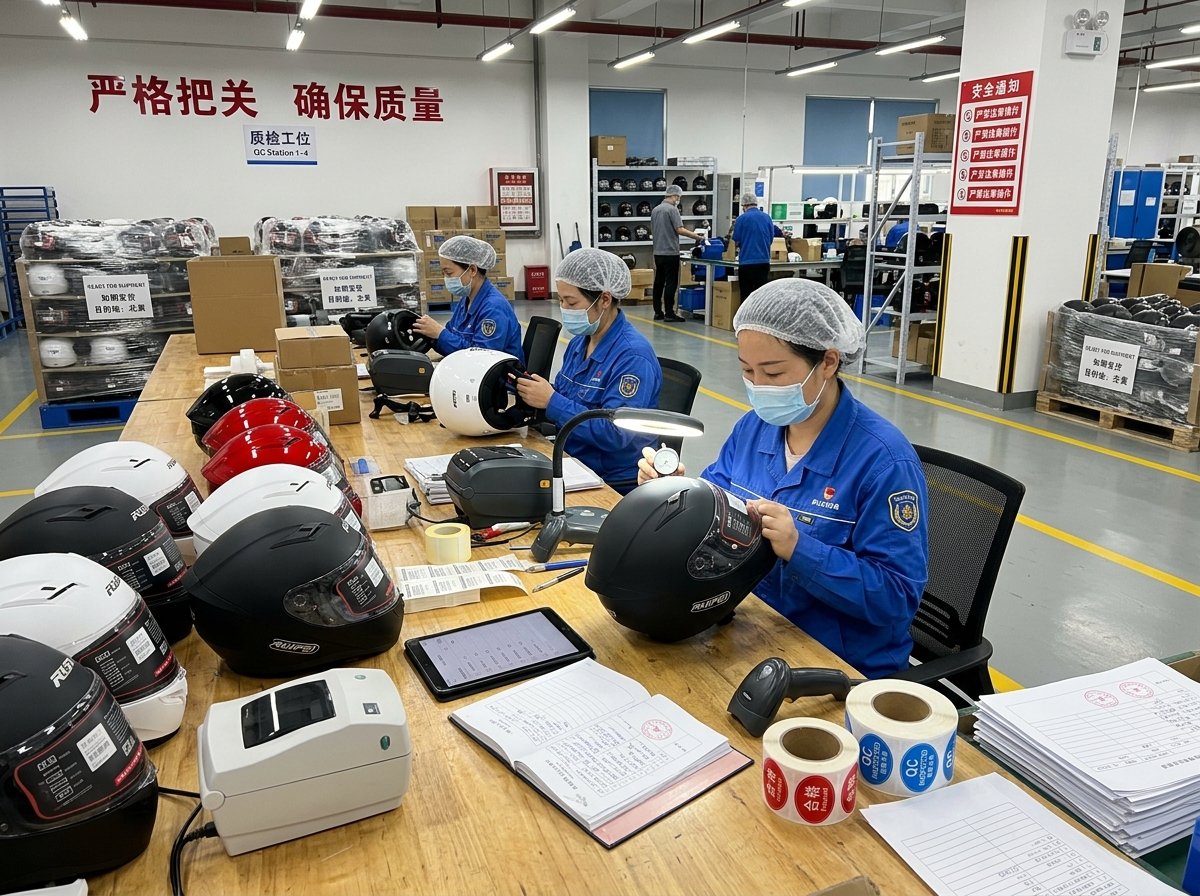
The inspection stage before shipment is where a large number of future problems can still be stopped. This matters because many market complaints do not come from dramatic failures. They come from daily-use frustrations. A visor that scratches too easily. A liner snap that pulls out. A shell finish that looks cheap. Left and right sealing that do not match. Wind entering through closed vents. These issues may seem small inside the factory, but they become public complaints once the helmets reach riders.
The most valuable pre-shipment inspections are the ones linked to real user pain points already visible in market reviews.
High-priority inspection points
| Priority point | Why it matters |
|---|---|
| Visor sealing and movement | Prevents leaks, noise, and poor user feel |
| Strap comfort and routing | Prevents throat pressure and wear complaints |
| Cheek pad and liner retention | Prevents loose padding and comfort decline |
| Paint and shell finish | Protects premium feel and retail presentation |
| Vent sealing | Reduces cold-air leakage and turbulence complaints |
| Inner fit consistency | Reduces pressure-point complaints |
| Packaging and labels | Prevents wrong-item, wrong-box, and gift-scene failures |
Bulk buyers should also check multiple sizes, not only one sample size. A helmet that performs well in medium may show pressure or assembly issues in XL or modular versions with more complex hardware.
How Do Factory QC Systems Actually Work?
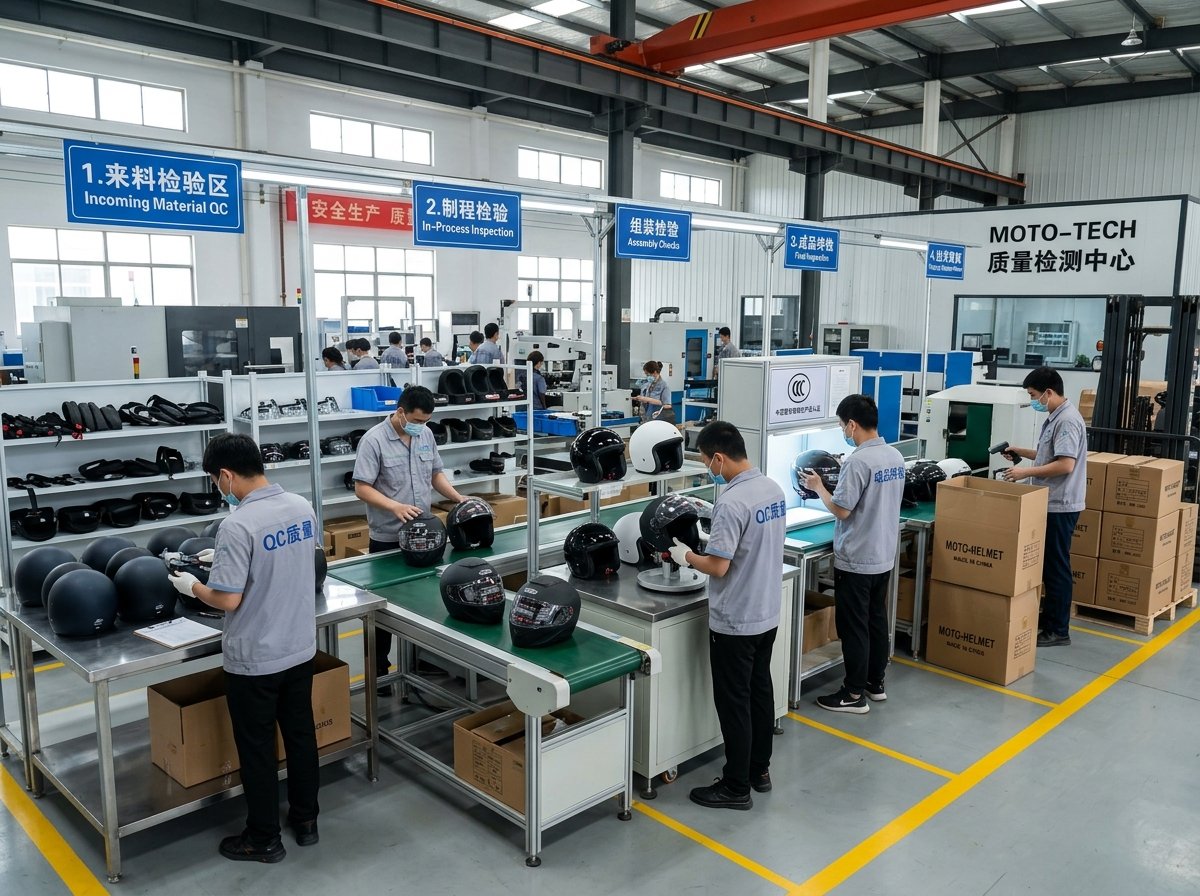
Factory QC systems usually include incoming material checks, in-process inspections, assembly checks, final inspection, and shipment review, all built to catch defects before they become market complaints.
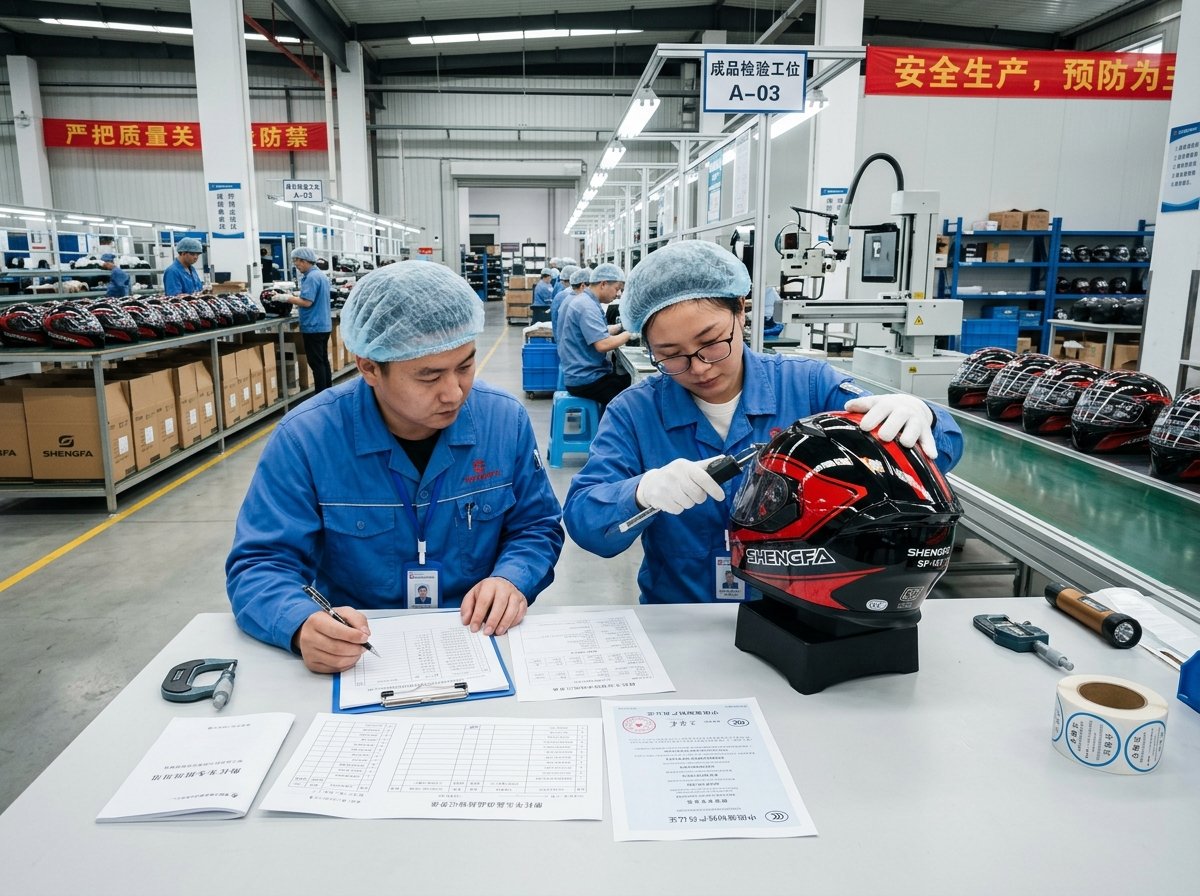
A reliable helmet factory should not inspect quality only at the end. Good factories build quality checks into every stage of production. Incoming material inspection checks shell materials, visor raw material, strap webbing, foam density, coatings, and hardware parts. In-process control checks shell molding, trimming accuracy, paint finish, EPS fitting, and sewing quality. Assembly control checks visor alignment, vent action, trim bonding, strap installation, and liner fit. Final inspection checks appearance, function, accessories, labels, and packaging.
This layered system matters because many helmet defects are easier to prevent than to fix. Once a visor pivot is assembled badly or a shell finish is scratched in packing, the problem may not be worth repairing. It is much better to catch the issue earlier.
Typical factory QC flow
| QC stage | Main focus |
|---|---|
| Incoming QC | Raw materials and purchased parts |
| In-process QC | Shell, EPS, paint, soft parts, trimming |
| Assembly QC | Visor, straps, vents, liner, moving mechanisms |
| Final QC | Function, appearance, labels, accessories |
| Outgoing QC | Carton accuracy, packaging protection, shipment condition |
A mature QC system is important not because defects never happen, but because the factory has a method to catch them before the customer does.
Third-Party Testing and Factory QC Systems Explained?
Third-party testing confirms that a helmet model meets required standards, while factory QC makes sure the production helmets continue to match that tested model in daily manufacturing.
This difference is one of the most important points for buyers. Third-party testing and certification are necessary, but they are not the same as daily production quality control. A helmet can pass certification on a submitted sample, yet still create market problems later if the mass-production batch shows poor visor fit, weaker liner quality, sloppy assembly, or inconsistent trimming.
Third-party testing proves compliance at the model level. Factory QC protects consistency at the batch level. Buyers need both.
Third-party testing vs factory QC
| Item | Third-party testing | Factory QC |
|---|---|---|
| Main purpose | Verify compliance and performance | Control consistency and workmanship |
| Timing | Before or during model approval | During every production batch |
| Focus | Impact, retention, penetration, standard criteria | Fit, finish, function, assembly, packaging |
| Result | Test report or certification | Lower defect rate and more consistent shipments |
When both systems work together, the buyer gets better protection against two major risks: non-compliance risk and inconsistency risk.
Which Defects Cause the Most Trouble After Delivery?
The most damaging defects after delivery are usually fit inconsistency, visor problems, strap discomfort, liner failure, and packaging errors, because these create immediate customer frustration and fast negative reviews.
The market insight patterns are very clear. Riders complain loudly about helmets that are too noisy, too tight, badly shaped, hot, fog-prone, or unreliable in parts like visors, snaps, straps, and internal sun shields. Retail channels also suffer when helmets arrive in the wrong box, without labels, with old stock dates, or with packaging damage that makes the product look used.
These are exactly the issues a buyer should pressure-test before approving shipment.
Common post-delivery defects
| Defect | Likely cause |
|---|---|
| Visor leaks or rattles | Poor seal fit or pivot tolerance |
| Padding loses support fast | Weak foam quality or poor durability testing |
| Strap digs into neck | Wrong geometry or poor assembly angle |
| Closed vents still leak air | Weak vent gate sealing |
| Wrong color or size shipped | Poor warehouse or carton verification |
| Helmet looks used | Weak packaging control or mixed stock handling |
For bulk buyers, these problems are expensive because they damage more than one order. They damage future confidence.
What Should Buyers Ask a Helmet Factory Before Approving Bulk Production?
Buyers should ask about inspection standards, golden sample control, defect thresholds, batch traceability, testing records, packaging checks, and how the factory handles sample-to-bulk consistency.
A factory may claim good quality, but bulk buyers need to see how that quality is controlled in real production. The right questions can reveal whether the supplier truly understands helmet quality risks or only focuses on output.
Useful questions for buyers
| Question | Why it matters |
|---|---|
| Is there a golden sample for each approved model? | Prevents drift from approved standard |
| What is checked during in-process QC? | Shows whether the factory controls defects early |
| Are visor, strap, and liner functions checked in final QC? | Targets the most common market complaints |
| How are cartons checked before shipment? | Reduces wrong-item and wrong-box risk |
| Is there batch traceability? | Helps solve later warranty or complaint issues |
| Are wear-cycle or durability checks done on key parts? | Protects long-term product reputation |
Asking these questions early helps buyers compare suppliers more clearly and avoid surprises later.
Conclusion
Motorcycle helmet quality control is not only about spotting defects before shipment. It is the system that protects product consistency, retail performance, and brand trust after the helmets reach the market. In this category, riders quickly notice weak points. They feel pressure on the forehead, hear wind noise at speed, see fog or scratches on the visor, and lose confidence when liners, straps, or moving parts wear too fast. That is why helmet QC must be tied directly to real-world use, not only to factory appearance standards.
For bulk buyers, the most important lesson is simple. A good sample is not enough. A certification report is not enough. A clean carton is not enough. Strong helmet buying decisions depend on checking whether the factory can repeatedly deliver the same shell quality, the same liner feel, the same visor function, the same assembly accuracy, and the same packaging condition across the whole order. The safest way to do that is to use a clear inspection checklist, compare against an approved golden sample, review factory QC methods, and confirm how third-party testing and batch control work together.
The strongest helmet suppliers are usually not the ones that only talk about materials or certificates. They are the ones that understand where customer complaints really come from and control those points before shipment leaves the factory. For buyers, that difference matters a lot. It lowers return risk, protects launch timing, improves channel confidence, and helps turn one successful order into a long-term product line instead of an after-sales problem.